
I’ve accomplished a lot this year, and here are the projects I’ve blogged about this quarter:
- Lightweight Hammock for Hiking
- Greenstyle Simpatico Leggings
- Lyon Sweater by PetiteKnit in Sandnes Garn Sunday
- Caramiya Tate Crop Top and Dress
- Jalie 4344 Sarah Period Underwear
- Know Me ME2041 Convertible Pants
- Lyon Sweater in Tosh DK by PetiteKnit
- MYOG Down Jacket: Steppjacke Vika from Meine Herzenswelt
I’ve completed several projects this quarter that have older blog posts:
Projects I have yet to blog about but will in the next month or two:
- Sage Tee by Elbe Textiles
- Strathcona Henley by Thread Theory Designs
Works in progress that I’m taking with me into next quarter:
- Trigg Shorts by Elbe Textile
- More Tula shorts from Papercut and Ponoma Shorts from Anna Allen
Totals
I have completed a total of 27 projects this year, which is three more projects than last year at this point.

I have spent a total of $1,308, which is $340 less than this time last year. My most productive sewing months are always January through April.
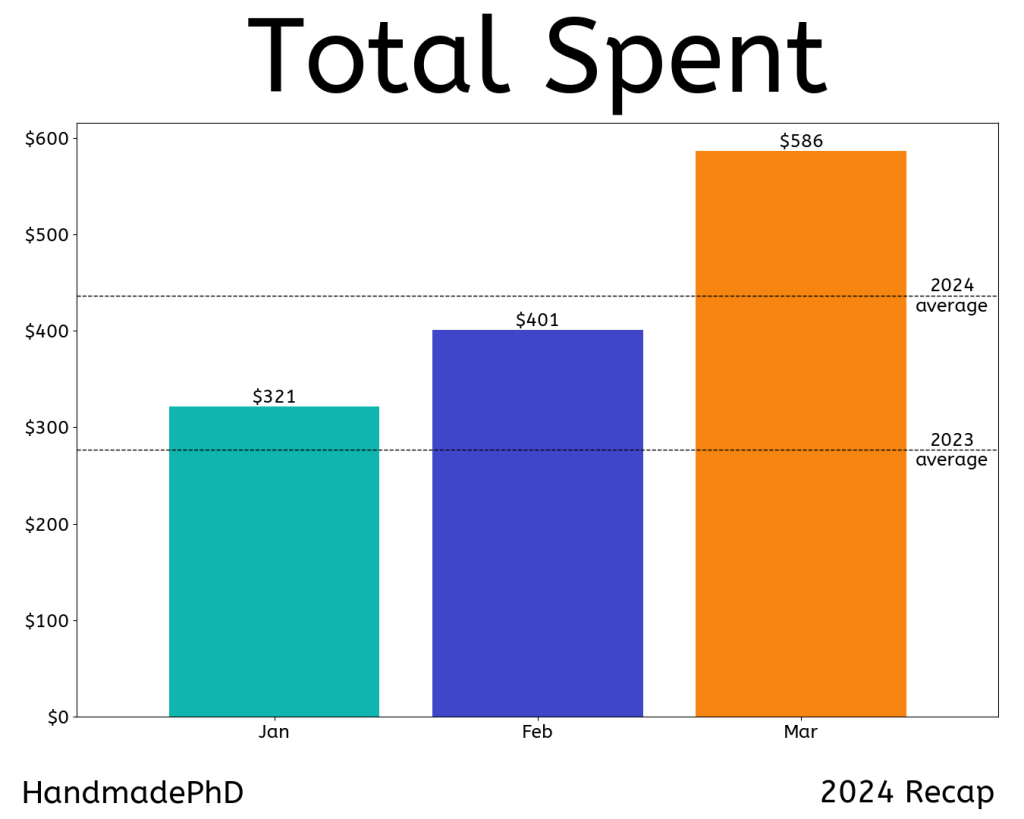
I have spent roughly 178 hours crafting. I didn’t track time last year in January, so I’m not sure how things compare.

Stash Usage and Fabric Waste
This year, I started keeping track of how much fabric waste (those little bits of scraps between pattern pieces when you cut out your pattern) I generate. As you can see from the patterns that generated waste, I’m between 24% and 43%. Trousers (ME2041, Pomona, Trigg, Trousers, and Tula) actually tend to be more economical, and I would have guessed they were the worst.
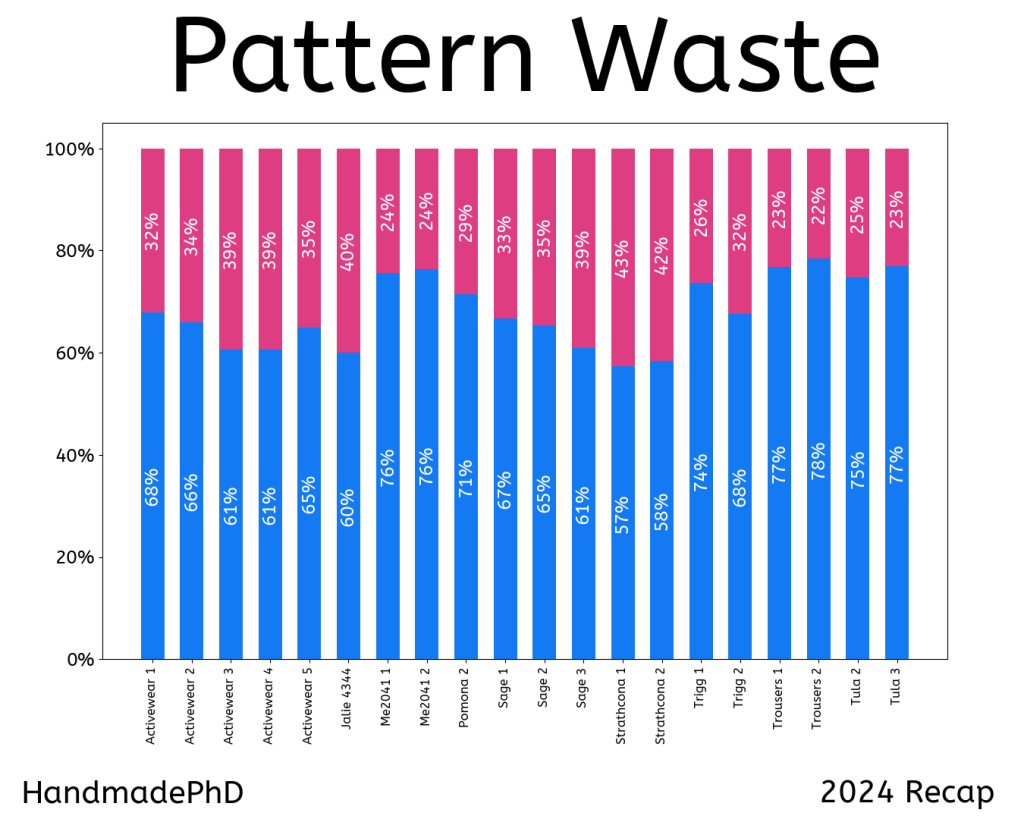
Most of my projects this year have been sewing repeats, so I’ve been able to buy just what I need and not extra.

I finished two sweaters in the last three months. One used yarn from an old sweater, and then I had to buy yarn for the second sweater. I’m also still working on all the sock yarn I bought last year. I’m currently reknitting a pair of socks that were originally knit too tight.

Finally, how long does my yarn or fabric sit in my stash before I use it? I’ve been super efficient this year and have used all the supplies I’ve received in the mail within 1 week 81.8% of the time. It’s helpful that many of my patterns are easy and/or repeated makes.

Cost and Time Breakdown
Of the $1,308, I have spent $811 on fabric (about 60%).
Notions include everything other than fabric: buttons, zippers, Whoopie sling and tree hugger for the hammocks, BanRol, and webbing for the integrated belts.
I’m still surprised at how much I spend on patterns, $61. I now understand why people wait for things to go on sale. It’s a huge cost.
The mockup fabric was the CV spandex I bought to test leggings, sports bras, and T-shirts.
Equipment this quarter was maskewire (Norwegian for ‘knit wire’) cords for knitting.

My task breakdown is as follows: almost 80 hours of knitting, 58 hours of sewing, 19 hours of testing, 11 hours of mending old projects, 8 hours of cutting fabric, and 2 hours and 30 minutes of taping together PDFs.
The sewing hours include the minutes it takes to clean my sewing room, set up my machines, etc. I put a new needle into my machines at the beginning of every project. At the end of the day, I ensure my sewing room is always tidied up, even if I’m still in the middle of a project.
The testing hours include cutting muslin, redrawing pattern pieces after edits, sewing the test garment, and standing in front of a mirror to assess fit. I’ve really gotten into a good groove testing patterns this year. I’ve had to test several tops, and I’ve been following J Stern’s workflow suggestion for fitting tops. It’s helped me address upper torso fit before worrying about bust and bottom torso fit. I’ll have more about my t-shirt adventures later.
Cutting fabric only involves cutting the final fabric for the garment, and not all the muslin cut during testing.
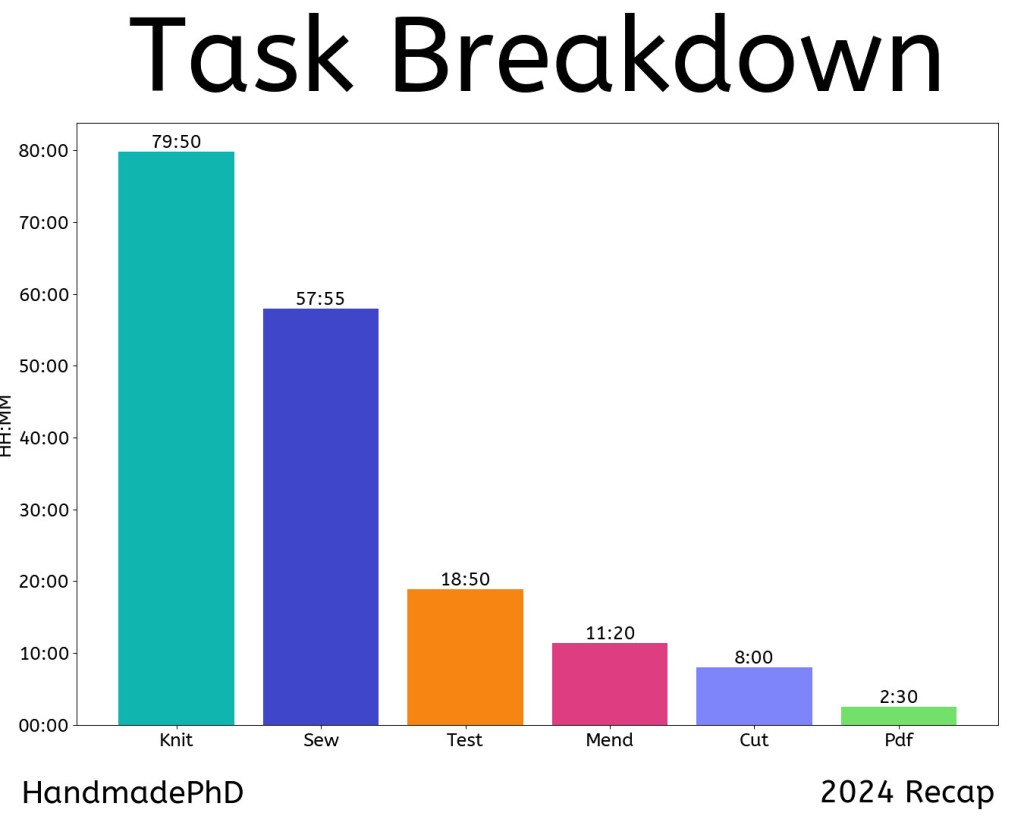
Finally, I calculated the number of hours I worked over the days from when I started taping together my PDFs or testing a pattern to when I finished my project. Most projects I can get done in a few hours across a day or so.

Project Breakdown
As is customary, I’ve sewn a variety of things already.
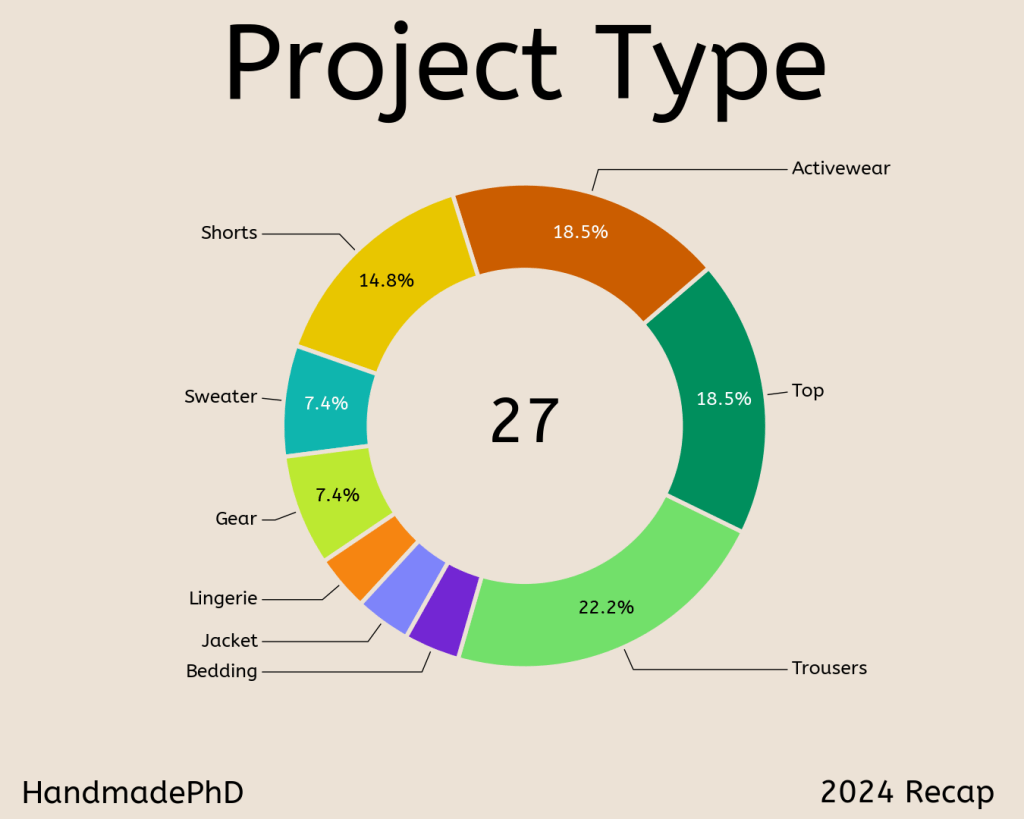
One of my goals this year has been to mend or alter things that still work with a few tweaks. I added front darts to two of Ryan’s work trousers and replaced the elastic in two pairs of my joggers and two shorts. These have been the biggest alteration/mend projects I’ve done to date. I’m really proud of myself for doing these projects and not giving up.

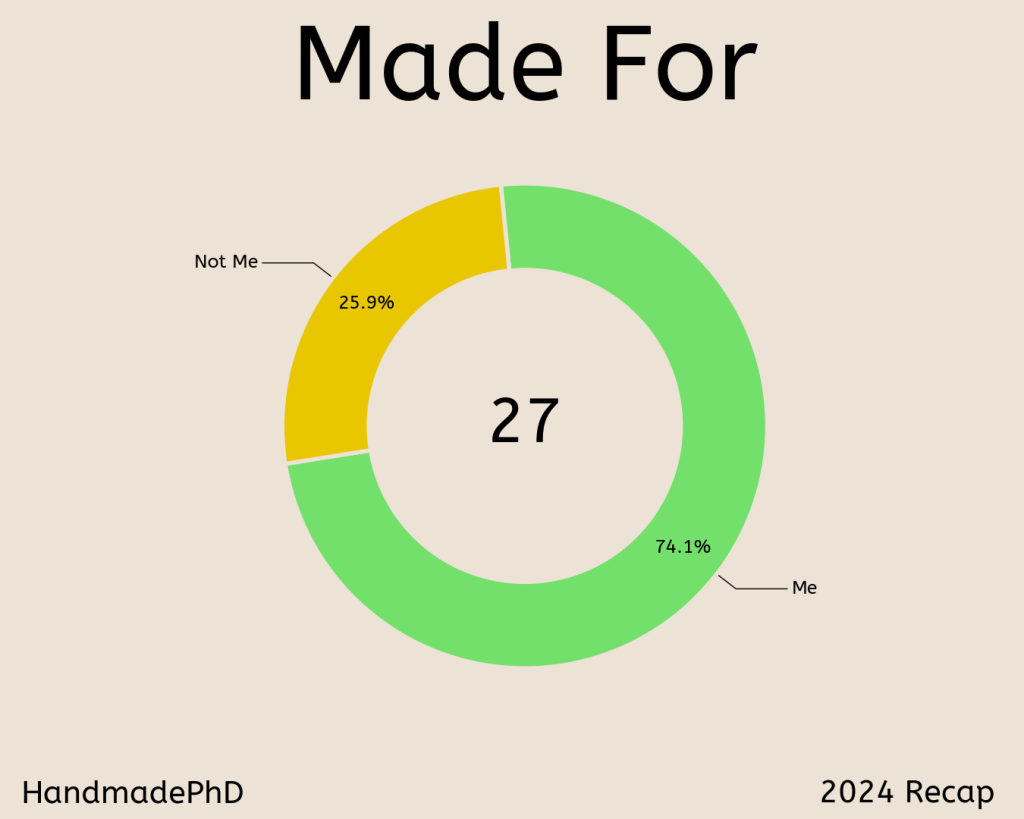
Most of the projects have been for me because a lot changed after my hospitalization in early February. One day, all of my activewear no longer worked for me, but part of my recovery is to make sure I’m getting a lot of exercise. I also needed extra absorbent period underwear for sleeping because of medication-induced changes in my menstruation. The list goes on…
The substrates I use are always varied.

Here are the stores I’ve shopped at in the last quarter. Wazoodle was a new one for me, and where I purchased PUL organic cotton knit fabric to make waterproof body pillowcases.

I’m actually happy when I’m not constantly using a self-drafted pattern because it makes it easier for others to replicate my projects. This quarter, the new pattern companies I tried are Caramiya, Meine Herzenswelt, and Know Me. I was really pleased with all these new patterns I tried.

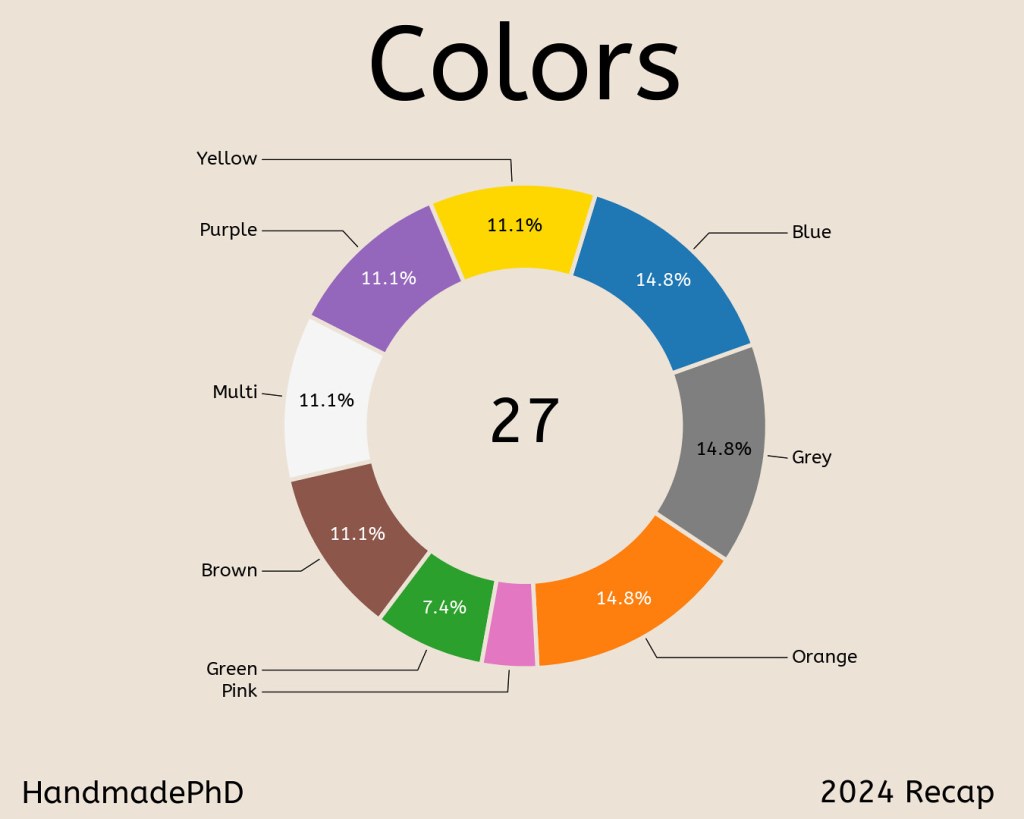
So, am I living up to my promise of picking more orange and yellow fabric this year? In 2024, yellow and orange each only made up 5.8% of all my projects. I’m definitely doing better this year than last.
Book Recap
My reading goals this year are falling behind. I’ve only read 7 books out of my goal of 60. However, I got to read what is now my favorite book of all time, Our Mutual Friend by Charles Dickens. I also enjoyed Patrick Stewart’s memoir.

Health Update

I still have mixed emotions about my health scare in February. On the one hand, I caught the clots “early” because none of the clots were occluding even though I had ignored symptoms for over 8 months. My recovery has been mostly going well. On the other hand, I could have easily been one of the many people that die each year. It’s been a lot to process, given I will forever have to worry about blood clots for the rest of my life. In February, I went to the hospital because of excruciating pain around my diaphragm. I hadn’t slept in 48 hours because I couldn’t lie down. It was too painful. I also was having difficulty taking a deep breath because of the pain. I needed to know what was wrong. At the hospital, they found many small clots throughout my lungs.
Because healing from a PE can take months, if not years, I’ve wanted to focus on my recovery and not worry about anything else. Thankfully, my recovery has been going well. However, I still have the occasional flare-up of diaphragm pain or pain in my leg that sends me into panic all over again. I’m not 100% out of the woods yet. The anxiety is definitely real and a huge part of my life now.
The nagging thought I have through this whole process is the fact that I ignored symptoms for nearly 8 months!! I had pain in my leg off and on for 8 months that I thought was just a pulled muscle or inflammation/arthritis in my hip, calf, and foot. I was constantly tired and often found it unusual that walking up and down the stairs at our three-story townhouse left me with an elevated heart rate (>100 bpm). The terrifying one was back in December; for about 3 days, I would have to pant to catch my breath if I moved or turned over in bed.
Besides the random pain, my resting heart rate was the only sign of something wrong that I completely ignored. My blood pressure and blood oxygen levels never were abnormal. Because I love data and graphing, here’s my RHR through the ordeal. For 2021 and 2022, my RHR had been an average of 54-55 beats per minute with a min/max range of 50 to 60. I never knew my RHR spiked in June last year. I was exhausted last summer and struggled hiking higher elevations, but I attributed it to stress.

From July through November, I occasionally had several week-long spikes in RHR that correlated with that unexpected pain in my leg, but it always “resolved” itself with rest. When I rested, I found compression socks and heating pads felt the best to manage the discomfort. However, by the time I got to December, the leg pain was nearly constant. Compression socks and heating pads were no longer working to manage my symptoms. I also started noticing my elevated RHR. I thought it was elevated because I was in pain, so it was “normal” and not something I should worry about. At this point, my heart rate rarely got down to average (55 BPM).
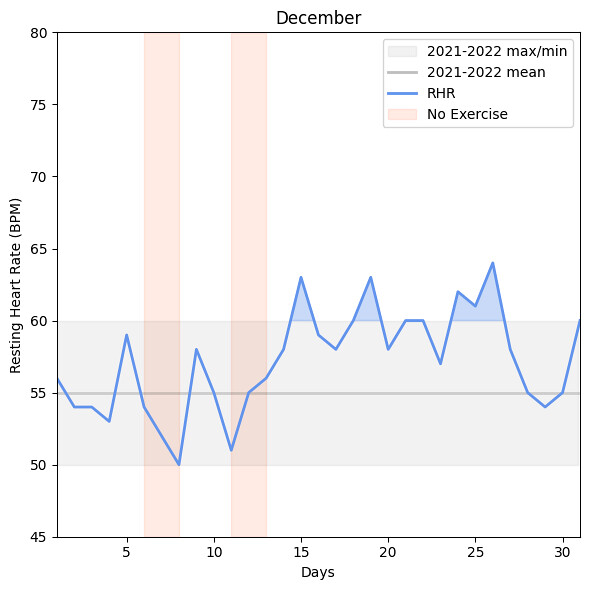
January was the first time part of my leg swelled up. I was unable to exercise or walk because the bottom of my foot and ankle were swollen and really painful. But I never got the classic discoloration or extreme swelling you might expect with a DVT.
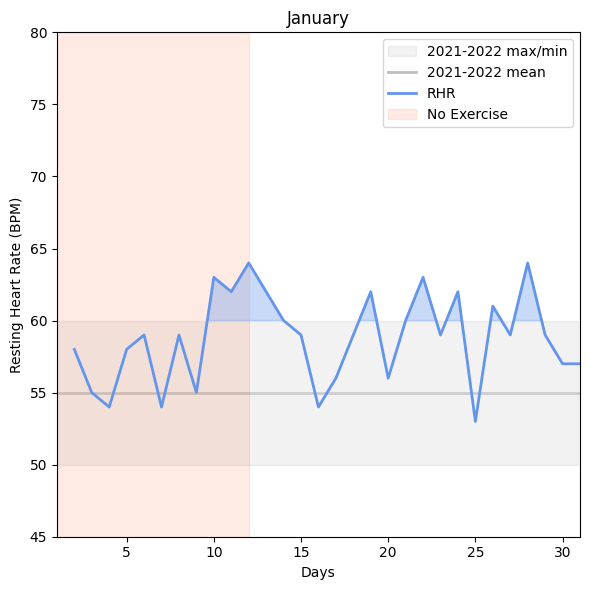
Then, in February, all hell broke loose. I went to the hospital in early February. Found out I had clots. And was immediately put on Direct oral anticoagulants (DOACs). Since then, I’ve been closely monitoring my RHR to make sure I’m able to get it back between 50 and 60 BPM.

March has been amazing. I’ve had those occasional moments of worry, but then everything is fine.

The Stop the Clot website has been an excellent resource for understanding my condition. Specifically, I have found a lot of comfort in hearing Katie Hoff’s story. We share the experience of being competitive swimmers, and her mindset and story resonate closely with mine. My default reaction to feeling out of shape or weak is to hike and work out more. Over the last eight months, I thought my leg pain was associated with an autoimmune disease or arthritis, and I knew exercise should help, so that’s what I did. I also thought I wouldn’t be so out of breath if I worked out and hiked more. I constantly attributed how I felt to just getting older now that I’m in my 40s, so I should work out and hike more.
In the days before my hospitalization, I completed a 6.5-mile snowshoe and a 7.5-mile hike. And yes, I had leg pain/numbness and was out of breath on both hikes, but as Katie mentions in her video, I’m so used to discomfort while exercising that I don’t think anything is wrong.
So, to end on a happier note, I celebrated walking/hiking over 100 miles in March. The last time I did that was in June when my RHR spiked. The lesson is that blood clots really can happen to anyone!

Conclusions
I spent a lot of time resting this last quarter and had to live on the couch for over a week when the pain was the worst. What gave me the most comfort was watching old and new live streams from Saremy’s SewSewLive YouTube channel. Those days before and after hospitalization, when I was struggling to sleep and was in excruciating pain, her videos were the perfect analgesic. I watched so many videos!
Here’s hoping the second quarter doesn’t throw me any more curve balls. Spring is on it’s way to Utah and I can’t wait for the snow to melt in the mountains so I can start hiking.

IF YOU FOUND THIS POST HELPFUL, CONSIDER SUPPORTING MY WORK BY SIGNING UP FOR A PAID SUBSCRIPTION.
POSTS OLDER THAN 3 MONTHS ARE NOW FOR SUBSCRIBERS ONLY — YOUR SUPPORT KEEPS THIS SPACE GOING.
INTERESTED IN SUBSCRIBING TO RECEIVE NEW POSTS IN YOUR INBOX?

Wow that was a close call, glad you’re ok!
On another note: I’m weirdly drawn to your charts and graphs. How much time do you think you spend collecting the data and crunching it into colorful packages? Are you a fan of Edward Tufte?
What initially took me a long time was writing all the code in Python to do everything. Now that it’s written, the process is really quick. Occasionally, I’ll spend an hour or so tinkering with new plots or summarizing data in a new way, but that’s because I want to learn more about data visualization in Python. Working with simple data like this makes it easier to visualize, unlike the extremely complicated data I analyze for work. This stuff is just fun for me! Thanks for the lovely comment.
Very sorry to read about your scary health issues. I hope your recovery continues and hiking can resume, along with some sewing.
All the best and thank you for such an interesting blog.
Thank you. I can’t wait to get back to the mountains and hike as well!
<hugs> I’m so sorry you have had to go through this! It sounds so scary. I can personally recommend a hormonal i u d for reducing heavy periods as that it is why I had mine placed. Thank you for sharing-not just this post but for all the informative posts. ❤️
It’s definitely too early to know what my body will do long-term with menstruation. That’s the worst part of dealing with blood clots and taking DOACs (direct oral anticoagulants). I am going to wait at least 6-12 months before deciding on a course of action. Thanks for your comment and hugs 🤗