
After trying pant patterns from several new companies (e.g., Open Studio Patterns, The Modern Sewing Co.), I’ve learned how important it is to be a better consumer. Yes, I am comfortable sewing pants and often ignore the nitty gritty details in the instructions because I have my preferred methods. However, suppose I speak only positively about a pattern riddled with typos, mistakes, and errors. What impact does that have on sewers who are less confident or familiar with pant construction? I’ve heard over and over again sewers blame themselves when something goes wrong or doesn’t work. Sewers often don’t realize it’s a mistake in the pattern and not a mistake with them. I just recently read Brave, Not Perfect. Saujani found that in the Girls Who Code classes, girls were more likely to erase their codes entirely and show none of their work at all than risk imperfection. In other words, when girls struggle with computer coding, they say, “There’s something wrong with me.” and not “There’s something wrong with the code.” When I post about a sewing pattern, I think sharing my mistakes, experiences, and perceptions is helpful and shows other sewers that struggling doesn’t mean outright failure. And it’s OK to critique a pattern; just because I point out issues or flaws doesn’t mean I dislike the pattern. As you will see in this post, I like how the Shop Pant was drafted, but there are some issues with the pattern pieces and instruction that, along with the sizing oddities, make this a tricky pattern.
Analyzing Style and Fit

There are some really unique features to the Shop Pant. First is the geometric front pocket. It isn’t like the traditional trousers slash pocket, but it isn’t a jeans curved pocket either. The front pocket is also really roomy! The next cool feature is the lower hem. Adding a piece to visually raise the hem gives the pants a chunky hem look. I’ve seen a version of this pant where the front hem and pocket facing were a different color. As a result, these pants have a lot of color-blocking potential. Or, if you use striped fabric, you could turn the fabric 90º. The final unique style is that the side seam is moved forward on the body. This visually creates a straighter profile when viewed from the front. Besides the unique features, the pants have a high waistband that’s slightly contoured, a barrel leg shape, the hem should fall at the ankle, and all the pockets are big and roomy.

The pants should be fitted from the waistband to the hip but not super tight. From the hip (AKA top of the crotch curve) down to the hem, the pants are roomy but should follow the shape of your body. Finally, the leg should taper at the ankle. There’s a decent amount of room through the bottom of the crotch curve, so the pants shouldn’t be clingy or tight. Some wrinkles under the butt are expected, given the generous length of the crotch hooks.
Materials and Notions
The fabric I used is 10.5oz upcycled denim in pale blue fleck from Blackbird Fabrics. The material is part of the New Denim Project from Iris Textiles, located in Guatemala City, Guatemala. I think 10-11oz is a perfect weight. Denim can be daunting to sew, so here’s what I used for construction and topstitching. I used a denim needle 90/14 with Gutermann Mara 100 thread for construction. For topstitching, I used a denim needle 110/18 with Gutermann Mara 30 Poly Wrapped Poly Core Thread.
I’ve always liked the YKK #5 Antique Brass Jean Zippers from Wawak. I usually just buy a whole bunch of zippers 7″ long and shorten them as needed.
Wawak also carries reliable buttons in a variety of finishes. The jean buttons are Plain Jean Tack Buttons – 27L / 17mm.
Determining the Correct Size
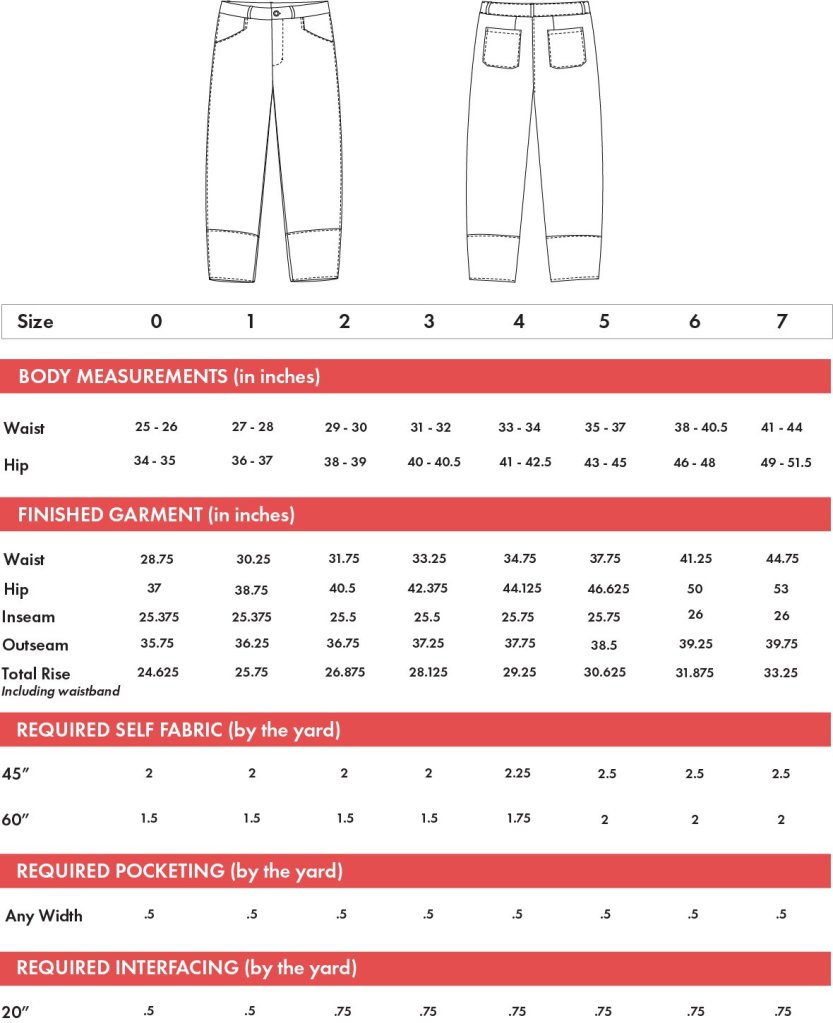
Check out my last post for more information about the previous sizing issues. I had a hard time determining my correct size. My waist measures 35 inches, and my hips measure almost 44 inches. That puts me smack dab in the middle of the size 5 range. However, if I consider my forward tilt, my hips measure closer to 45.5. I like to use the final garment measurements to confirm my size. I knew size 5 might be tight, but even with the TDCO method, the pants were unwearable. The table says the final hip measurement for size 5 is 46.625, but I haven’t figured out where that measurement is taken. I could only measure up to 45 inches at the widest part of the pants. The next size, size 6, is a big jump. For all the pants I’ve made recently, there’s been a size in between.
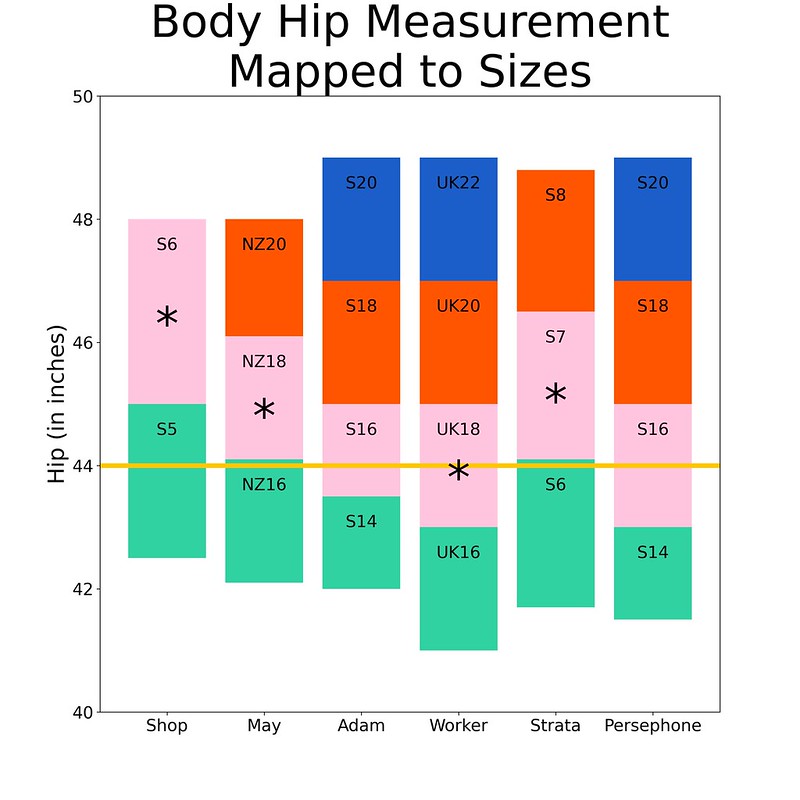
I pulled some numbers from other companies/patterns. I’m comparing the Shop Pant to May from Make by TFS, Adam from Daughter Judy, Worker from Modern Sewing Co., Strata from Papercut, and Persephone from Anna Allen. In the graph above, the different patterns are along the x-axis. The recommended hip measurement in inches is along the y-axis. I’ve color-coded each size separately. The yellow horizontal line represents my current hip measurement. I’ve placed a star on the pattern/sizes that I’ve made recently and fit. The May Jeans and Strata patterns have that extra size, so it made sense to go up a size since I was on the edge and knew I needed a bit more wiggle room to accommodate my forward-tilted pelvis. The Worker Trousers have a very generous fit, and I conveniently fit in the middle of their UK18 size. In the end, I just had a hard time wrapping my head around the fact that with the Shop Pant, Size 5 was too small, and Size 6 was too big.

Subscribe to continue reading
Become a paid subscriber to get access to the rest of this post and other exclusive content.
