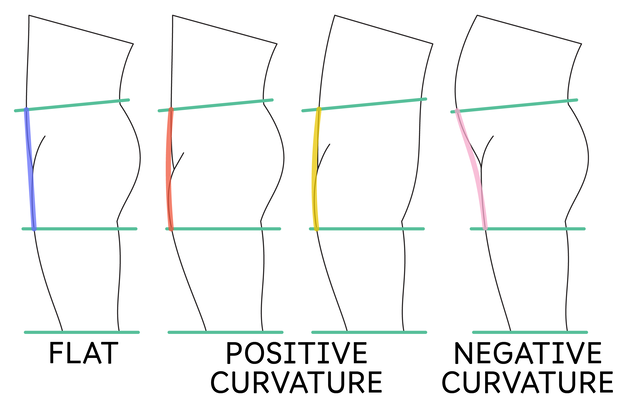
It’s been nearly three years since I talked about adding a front dart to Ryan’s basic trouser block. At the time, it was a completely improvised solution—something I pieced together from studying bespoke trousers in James Bond films and trusting my instincts about what needed fixing. Since then, I’ve deepened my understanding of how fabric can be shaped to conform to three-dimensional surfaces and why that dart worked so effectively.
I want to break down these concepts with greater clarity, share what I’ve learned, and demonstrate why that original intuition was actually correct. I’ll also introduce a clever method for incorporating—or even hiding—front darts in patterns like classic five-pocket jeans. The Wardrobe By Me Men’s Jeans pattern does indeed include a hidden front dart, but let’s not get ahead of ourselves.
Understanding Three-Dimensional Shapes
Adam Savage often describes needing to “put an object into his body” to fully understand it. He’s capturing that crucial moment when something transforms from merely being observed to being truly comprehended—when you develop a complete mental model you can manipulate in your mind.
Consider something as simple as an apple on a table. Your brain performs an extraordinary sequence of operations to convert light into meaningful visual information.
The process begins when light reflects off the apple and enters your eye through the pupil. This light carries encoded information about the apple’s color, form, and luminosity. Inside your eye, millions of specialized photoreceptors—rods and cones—detect this light. Cones enable color perception and fine detail recognition, while rods function better in low light and detect motion.

These photoreceptors convert light into electrical impulses that travel via the optic nerve to your brain’s occipital lobe. This region functions as a master pattern-recognition system, integrating separate signals about edges, colors, movement, and brightness into a coherent visual image. Different neural clusters specialize in detecting specific features—some focus on horizontal lines, others on curves, and still others on motion detection.
Once your occipital lobe constructs the visual image, your temporal lobe takes over to identify what that object actually represents. This area stores your visual memories and compares new images to your accumulated visual experience. Our brain’s ability to recognize variations of familiar objects is remarkably fast and efficient.
Finally, your parietal lobe helps you understand how that apple exists in three-dimensional space. This region enables you to mentally rotate the apple, recognize it as the same object from different viewing angles, and judge its distance from you. It’s what allows you to reach out and grasp the apple accurately. These steps occur within milliseconds, creating the seamless experience of simply “seeing” an apple.
If you live somewhere where apples are common, your brain becomes so familiar with their form that you can close your eyes and clearly visualize an apple. You can mentally rotate that imaginary apple, picture it from various angles, or even envision taking a bite—all without observing a real apple. This happens because your brain has stored such detailed visual memories that it can recreate the entire visual experience using the same neural pathways that process actual vision.
The Art of Externalizing Mental Models
Apples are relatively simple—rounded, smooth, typically red, yellow, or green. Yet unless you’ve spent considerable time sketching apples under various lighting conditions and from multiple angles, you’d likely struggle to draw one from memory. This represents the second half of Adam Savage’s challenge: conveying what he visualizes mentally to others. On MythBusters, Adam and Jamie developed an effective collaborative rhythm, sketching or describing ideas in ways the other could immediately grasp. This shared visual language made their partnership successful.
But what happens when the object is more complex or unfamiliar, like a new garment pattern? While it helps when pattern designers show their work on different body types, in varied fabrics, and from multiple perspectives, we as sewists must also build our own understanding. Here’s a systematic approach of creating a mental representation of a garment:
Study the Pattern Comprehensively
- Read pattern instructions multiple times.
- If online sew-alongs or YouTube videos are available, watch them several times.
- Print and assemble the PDF pattern, then spend time examining it closely. Really study the shapes and understand how pieces connect. The physical act of printing and taping provides opportunities to examine pattern pieces more carefully than simply printing at a copy shop or using an overhead projector.
Analyze Pattern Construction
- Draw in seam lines and walk pattern pieces to verify notch alignments and that tops and bottoms of seamlines match as they should.
- Check for smooth transitions around armholes, crotch curves, waistlines, and necklines. Learning how to evaluate a pattern is an invaluable skill.
- Identify and mark key construction lines: vertical drape line, horizontal chest, hip, and knee lines.
- Determine whether the pattern is balanced (page 23 of my eBook).
Test and Iterate
- Create multiple test garments using muslin or inexpensive fabric, evaluating construction lines while wearing the garment. For example, using my laser level method to check the vertical drapeline on pants.
- Use a dress form if available—draping reveals things flat pattern work cannot.
- Practice sewing challenging sections in isolation: zippered flies, collar construction, or plackets.
- Sew the complete pattern multiple times. This builds understanding not just of construction, but of shape, fit, and how different fabrics behave.
Personally, I rely on 3D rendering software like VStitcher or Clo3D. VStitcher allows me to manipulate and analyze garments on various body types in ways impossible in real life. And, if I had unlimited resources, I absolutely would have a Beatrice Form for both Ryan and myself!
All of this helps you build a clear mental representation of the garment and gives you something you can rotate, adjust, and troubleshoot mentally. Just like learning to draw an apple, fitting clothes well requires extensive repetition, curiosity, and willingness to experiment.
Understanding three-dimensional objects means studying them in multiple forms, from various angles, in both real and imagined space. This kind of intensive practice builds not only visual literacy, but also problem-solving capabilities. By learning to deconstruct 3D objects for understanding, you also learn to break complex tasks into manageable steps. That skill helps you take on more challenging projects.

Subscribe to continue reading
Become a paid subscriber to get access to the rest of this post and other exclusive content.
