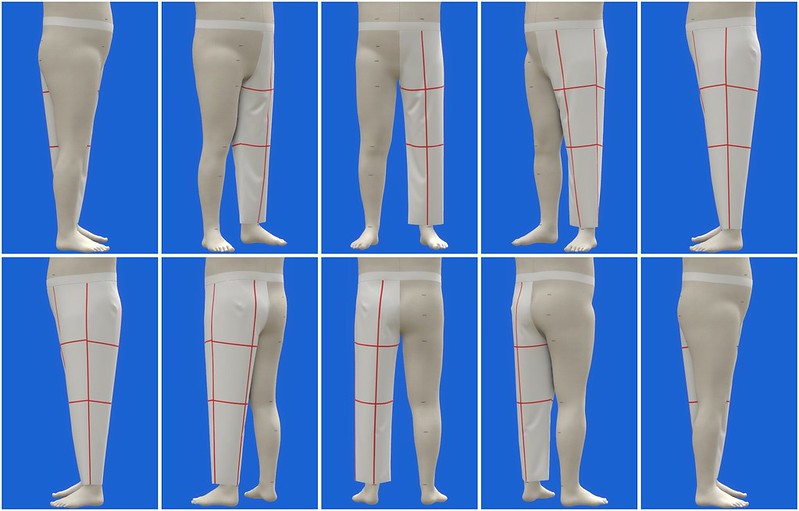
When pinning pants to the waistband, it’s crucial to balance the leg properly, regardless of whether you’re using my method or some other method1-7 for adjusting the fit of pants. Before starting this tutorial, ensure that you have selected the appropriate size based on your hip circumference, taking into account any prominent body parts. Moreover, it is important to establish exactly where you want your waistband to sit and the overall circumference of the waistband. Finally, it is assumed the waistline, the top seam of the pants, and waistband circumferences are the same, eliminating the need to modify the side seam of your pants.
So, what factors should you consider when balancing the leg?
- The seams running down the center front, center back, and sides of the garment should align with the corresponding notches on the waistband and your body. For example, the front center seam should align with your belly button, the back center seam with your intergluteal cleft (AKA butt crack), and the side seams should run vertically along your sides.
- The center front and back above the crotch curve should fit comfortably against your body without any strain or pulling. In other words, the seam should be smooth and flat. If the length is too long, the fabric may ripple and create gaps, while too little length can cause discomfort and wedgies.
- The crotch curve refers to the curved area between the legs of the garment. The bottom of this curve, which is the lowest point, should be adjusted to match your personal preference and the intended style of the pattern. However, it should not be pulled up excessively high, as this can cause the fabric or your body to distort, resulting in an uncomfortable fit and, again wedgies. Nobody wants the discomfort of their pants being forcibly pulled up to the extent that they feel as though their pants are splitting them in two.
- The side seam and inseam are the seams that run along the sides and inner legs of the garment, respectively. When you wear the pants, these seams should hang vertically without tilting or swinging towards the front, back, or sides.
Normally, the front and back center grainline will likely not hang straight because adjusting their placement with the laser level comes after this step. However, for this example, I am starting with aligned pants.
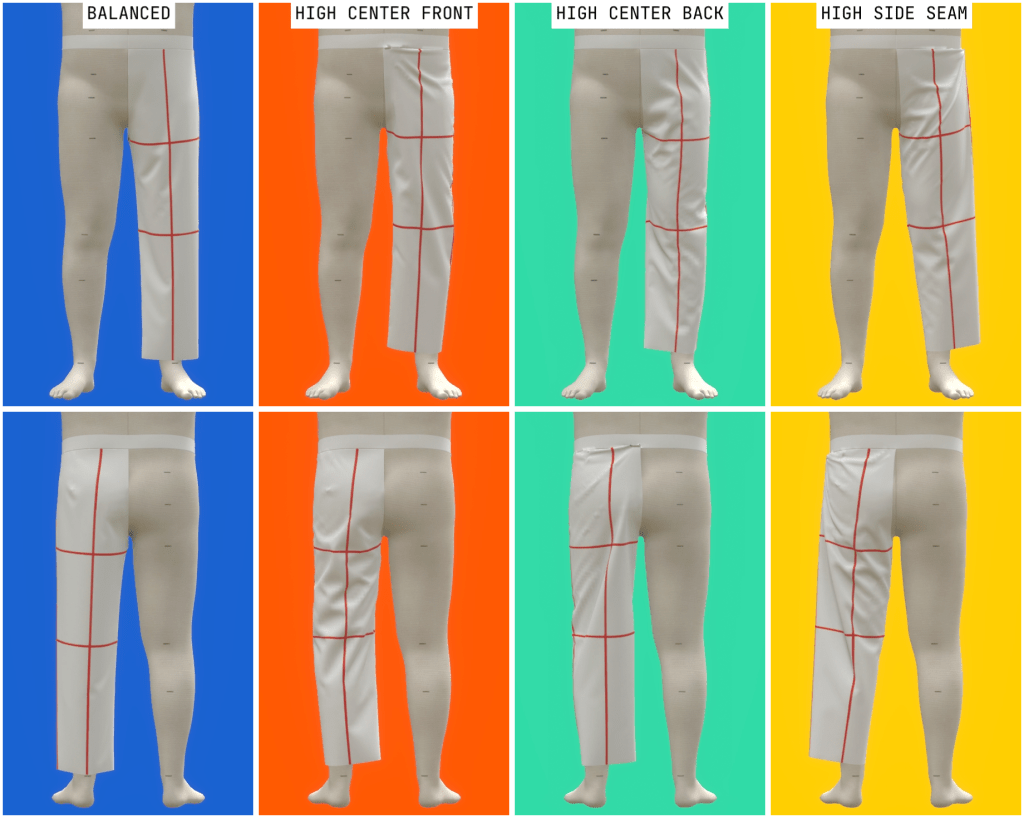
Center Front is Not Pulled Up Enough
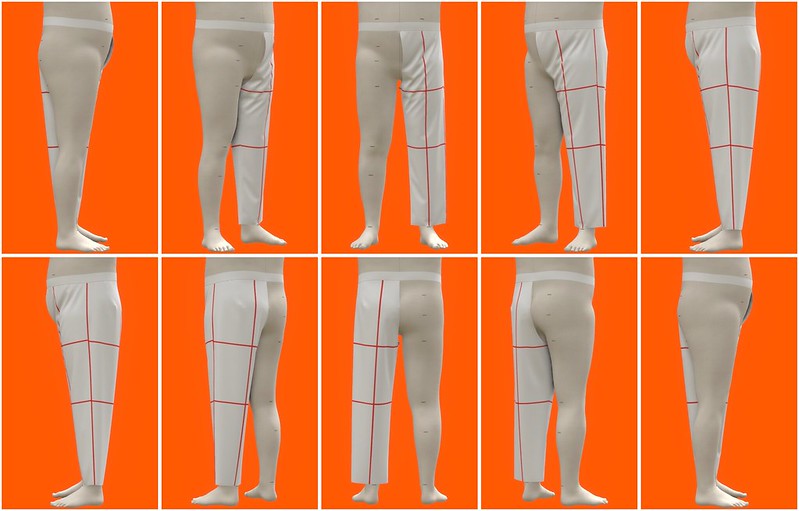
- The seam does not sit smoothly against the body, and a gap exists between the body and the pants. The center seam swings to the side and is no longer aligned with the middle of the body. The front of the pants does not fit snugly against the front of the body.
- Diagonal draglines become apparent around the front torso, originating from the bottom of the crotch and extending up to the side seam. These diagonal lines indicate the fabric is being pulled up unevenly along the bias.
- The entire leg of the pants tends to swing towards the back, and in some instances, you can see the inseam and side seams are no longer vertical. This imbalance causes the front leg of the pants to fall against the front of your ankle. The fabric may gather and bunch up near the front of the ankle instead of hanging smoothly.
Center Front is Pulled Up Too High
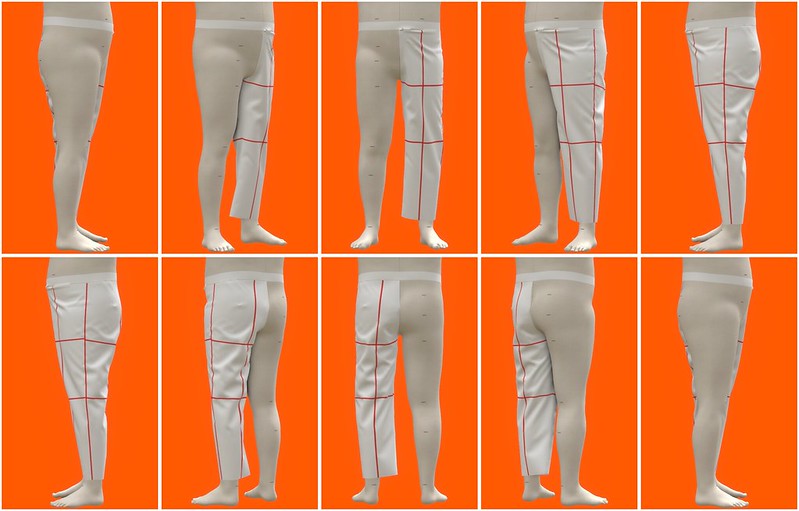
- The center front seam sits tightly against the body and causes the crotch curve to dig into the body. This means that the front seam of the pants may be uncomfortable and annoying.
- Draglines become visible around the front torso, starting from the top of the center front and extending diagonally down to the side seam. These diagonal lines indicate the fabric is strained and pulled unevenly along the bias.
- The entire leg of the pants is being yanked toward the front. Specifically, the back leg experiences draglines and tightness due to excessive forward tugging. The fabric on the back leg becomes strained and creates visible draglines.
Center Back is Not Pulled Up Enough
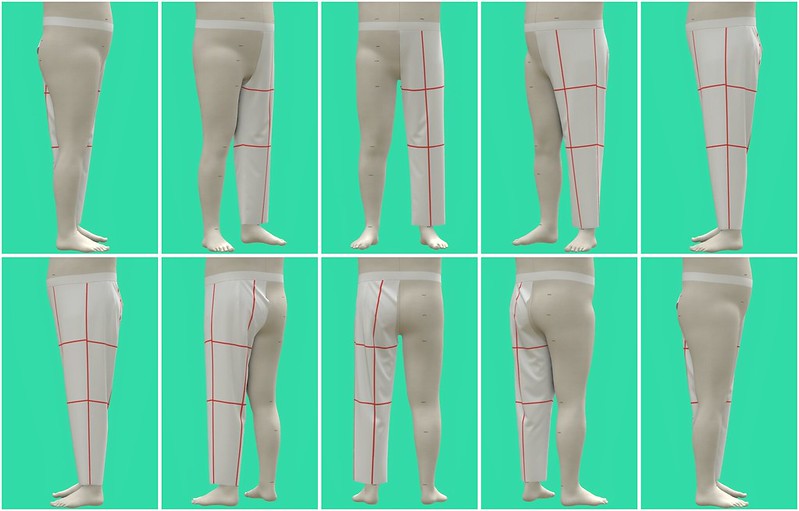
- The center seam will not sit smoothly against the body like the front. A gap will exist between the body and the pants. The center seam will also not hang straight with the body but will swing to the side and away from the center.
- Besides the draglines around the torso, draglines will also appear underneath the buttocks and across the hamstring area due to fabric sagging in those regions.
- The entire leg of the pants tends to swing towards the front. This imbalance can cause the back leg of the pants to fall against the heel and pool.
Center Back is Pulled Up Too High
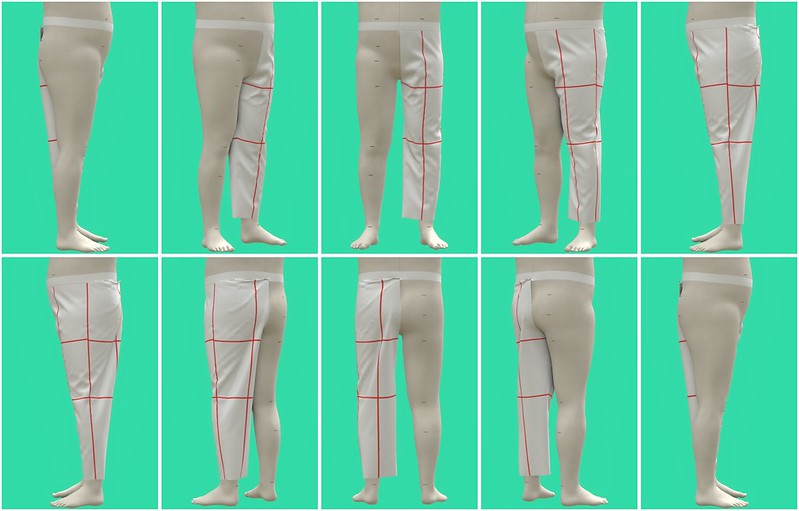
- The center back seam sits tightly against the body and causes the crotch curve to dig into the body. This means that the back seam of the pants may be very uncomfortable.
- Draglines become visible around the back torso, starting from the top of the center back and extending diagonally down to the side seam.
- The entire leg of the pants is being unnaturally pulled toward the back. Specifically, the front leg experiences draglines and tightness across the thigh and crotch area due to excessive backward yanking. The fabric on the front leg becomes strained and creates visible draglines.
Side Seam is Not Pulled Up Enough
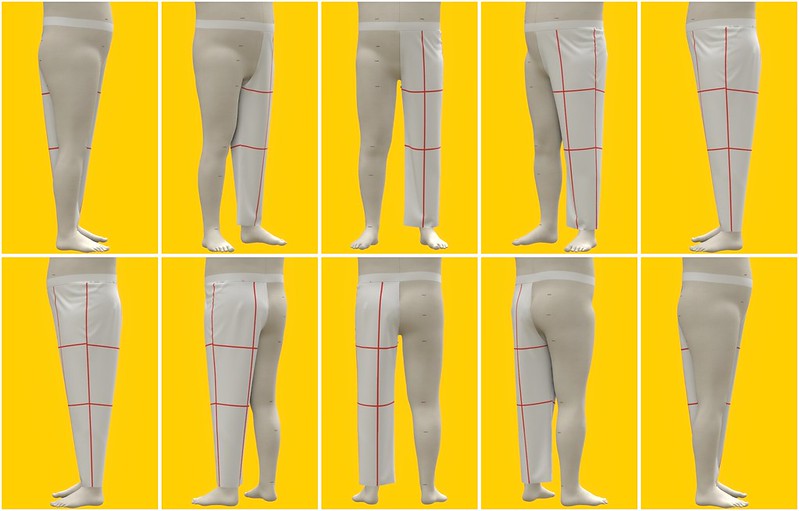
- The seam does not sit smoothly against the body, and excess fabric pooling around the hip.
- Diagonal draglines can be seen around the side torso, starting from the center front and back and extending diagonally down to the side seam.
- The side seam and inseam will no longer be balanced from left to right, and the pant leg will swing towards your inseam. The side seam may pool against the outside of your ankle.
Side Seam is Pulled Up Too High
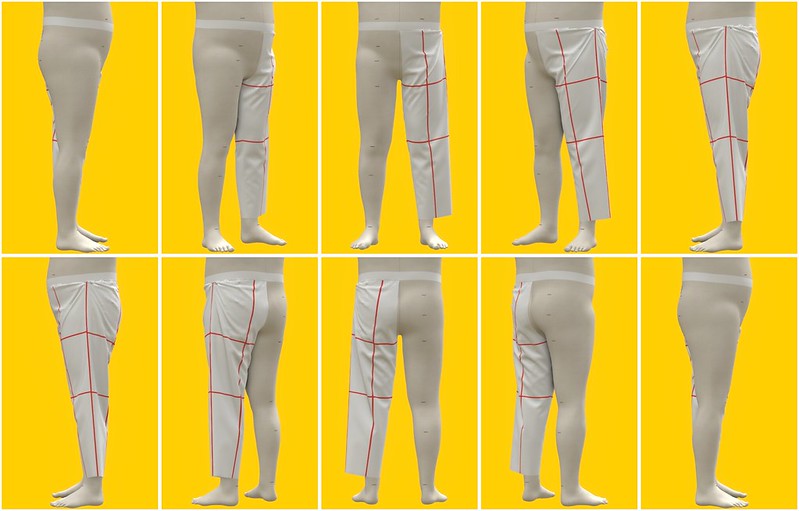
- Draglines are visible around the torso. These diagonal lines indicate that the fabric is being pulled and strained in an uneven manner. The draglines typically originate from the crotch area and travel diagonally toward the side seam.
- The pant leg tends to swing towards the side seam because it is being pulled in that direction. Additionally, the inseam seam, which runs along the inner leg, will be pulled against the inside of your ankle.
Conclusion

Take your time with this step when testing a pattern. I didn’t get into the sensation that results when you move around in the pants because I think it will be different for everyone. However, let me say briefly that unbalanced pants will result in the waistband moving up and down and the pants falling or getting pulled up. Ideally, the pants should fit comfortably, and the waistband should not shift excessively while standing, sitting, or walking up the stairs. Go ahead and test these basic movements to see if your waistband shifts a lot.
These methods are also included in my Google Docs reference guide (see link in the menu bar). Eventually, if I keep adding to my reference guide, I will have a whole book written about how to fit and adjust pants! How exciting.

IF YOU FOUND THIS POST HELPFUL, CONSIDER SUPPORTING MY WORK BY SIGNING UP FOR A PAID SUBSCRIPTION.
POSTS OLDER THAN 3 MONTHS ARE NOW FOR SUBSCRIBERS ONLY — YOUR SUPPORT KEEPS THIS SPACE GOING.
INTERESTED IN SUBSCRIBING TO RECEIVE NEW POSTS IN YOUR INBOX?

Sources
- Pati Palmer and Marta Alto, “Pants for Real People: Fit and Sew for Any Body!” Palmer/Pletsch, 2003.
- Joyce Murphy, “To Fit Pants, Start at the Waist,” Threads, 119, June/July 2005, 34, https://www.threadsmagazine.com/project-guides/fit-and-sew-pants/to-fit-pants-start-at-the-waist.
- Karolyn Kiisel, “Draping: The Complete Course,” London: Laurence King Publishing, 2013.
- Nick Verreos, “How to Drape Pants: Part One,” March 11, 2017, https://youtu.be/Wp38s7lMQu0.
- Nick Verreos, “How to Drape Pants: Part Two,” March 11, 2017, https://youtu.be/x8BOYxvn3OI.
- The Crooked Hem, “Part 8: Fitting the Toile”, September 22, 2022, https://youtu.be/yhi6qk0Wrqs.
- Pati Palmer, “Fit and Sew Contour Waistbands,” Palmer Pletsch Sewing Blog, March 4, 2023, https://palmerpletsch.blog/fit-and-sew-contour-waistbands.
Further Reading
- Sarah Veblen, “The Complete Photo Guide to Perfect Fitting”, Minneapolis: Creative Pub. International.
- Alexandra Morgan, “Fitting Pants: The Crotch Curve”, In-House Patterns Studio, October 2, 2018, https://www.inhousepatternsstudio.com/blog/fitting-pants-the-crotch-curve.
- Ruth Collins, “Top Down, Center Out: Practical Pants Fitting,” Threads 218, Summer 2022, 50.

Hi!
The video in your references list (above) from The Crooked Hem lists several starting points to become familiar with the work of Ruth Collins. (She is mentioned by name.)
I maybe wasn’t clear – she included some of her references in her comments about her video.
I appreciate your follow-up. It’s important to me to use reliable and pertinent sources that I have personally reviewed. As such, I have purchased and read the article in the #218 issue of Threads on Kindle to ensure its accuracy. The reference has been included.
If there are any more references that I could add, please feel free to share them with me.
Wow, not a mention of Ruth Collins! Did you do the “one legged toile and a fitting waistband” before 2021? There is no way you have been unaware of her massive contribution to the process of fitting pants. (Pleased you are now distinguishing between Grainline & Centerline – conflating the 2 was very confusing.)
Yes, Ruth does not dwell much on vertical and horizontal lines as you do. However, the fitting you describe is derived from *her research & work.
Thank you for your comment. Can you please provide a direct reference that describes this process in detail that I can include with my other references? Is there a specific blog post, YouTube video, or published article? I’ve included what references I’ve seen and read about pertaining to draping from the waistband. Thank you again for your feedback and any references you can provide.