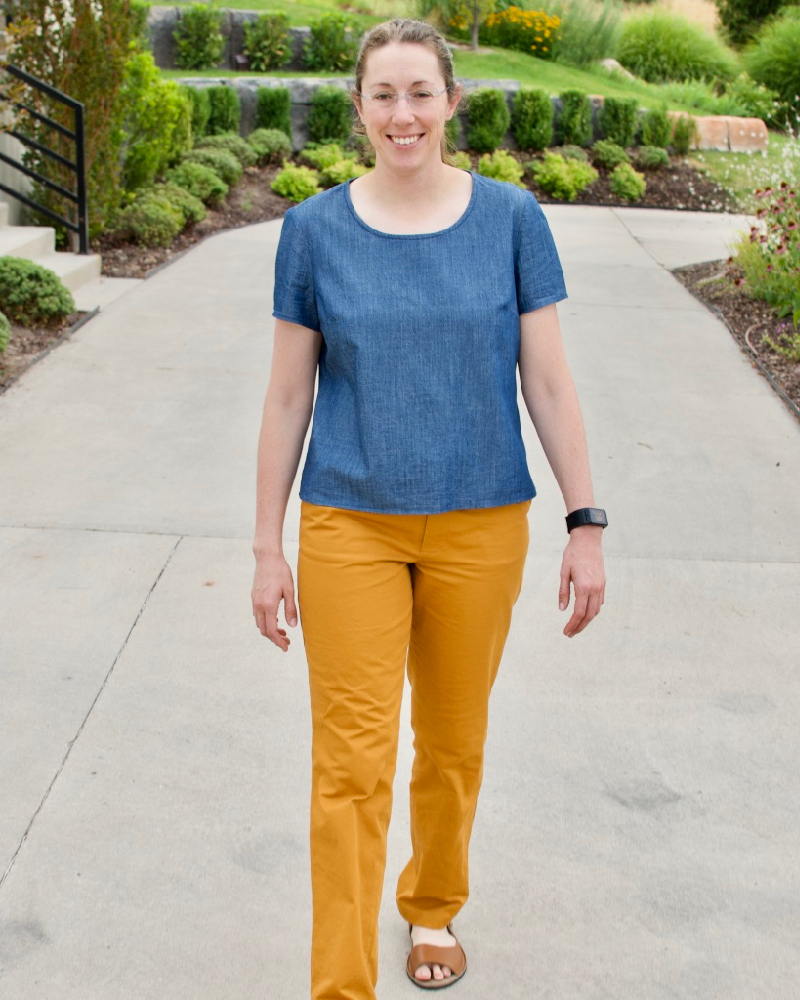
The first pair of trousers I made from my duct-tape sloper was a pair of stretch skinny jean shorts. I had previously made skinny jeans so I was able to compare my self-drafted version with an altered pattern. This time around, I am trying a new pattern, Alina Sewing + Design Co. Chi-Town chinos Expansion Pack No. 2. I have been futzing with this pattern for months now and could never get the fit right. I now understand why.
DRAFTING PATTERN
If you need a refresher on how to create a duct tape sloper, here’s a link to that post: https://handmadephd.com/2018/07/11/quick-sloper-using-duct-tape/.
FRONT LEG
I dropped the waistline down a ½ inch. This change is arbitrary and has more to do with where I wanted my trousers to sit. I added ¾ inch to the side seam, inseam, and along center front. I stopped when I got to the crotch curve and just blended the existing curve down to the inseam. Using the Chi-Town chinos pattern, I added the front fly extension and cut out the shape of the front pocket. I had to also redraft the front pocket pieces, but that was straightforward once I got my front pant piece figured out.

Let’s discuss how I drafted the leg from the knee down. The patterns I have used up to this point are Simplicity 8056 and Simplicity 1696. My old pattern fit pretty well. I was never quite happy with the upper part of the pant, but the leg fit was always perfect. I used my old pattern to finish the leg here.
BACK LEG
I dropped the waistline down a ½ inch. I added ¾ inch to the side seam and along center back. For the inseam, I added 1-½ inch at the crotch curve and quickly graded it back down to ¾ inch along the rest of the inseam. Like the front, I blended the back crotch curve into the inseam. I used the original Chi-Town chinos pattern to drafted the dart (not shown) and I used my old pattern (based on Simplicity 8056 and 1696) to finish the leg from the knee down.
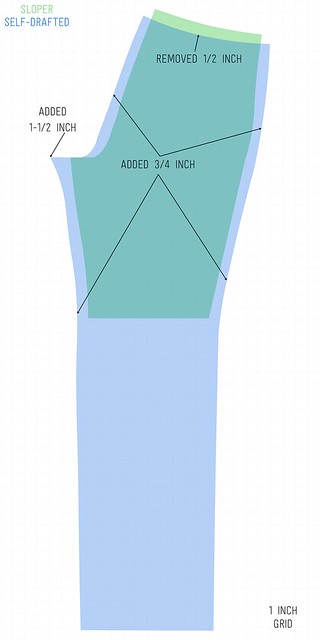
Why choose ¾ inch to add around everywhere? It was an educated guess. The Chi-Town chinos call for a ½ inch seam allowance. If your pattern uses a ⅝ inch seam allowance, then you’ll need to add ⅛ to ¾, in other words, you’ll need to add ⅞ inch everywhere and 1-¾ inch to the back crotch curve.

Subscribe to continue reading
Become a paid subscriber to get access to the rest of this post and other exclusive content.
