
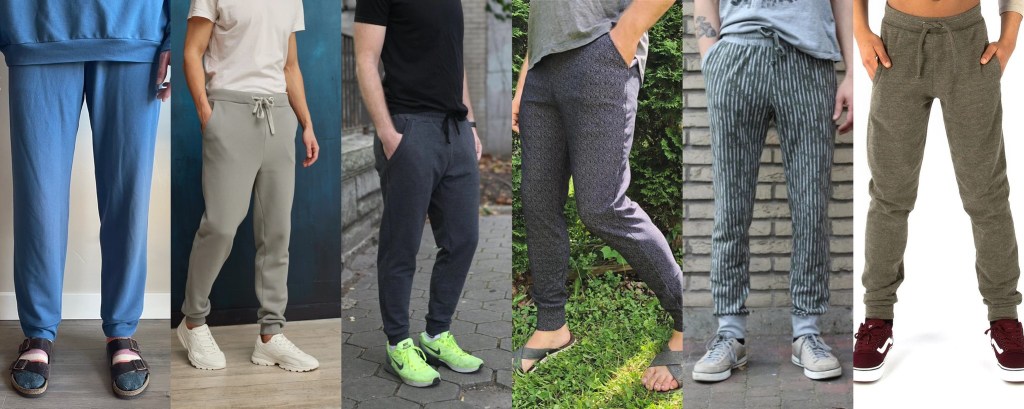
Sometimes my curiosity gets the better of me and I end up down some really deep rabbit holes. This ended up being one of those big rabbit holes. The hole I jumped into was, “What actually constitutes a jogger pant”.
It has almost been a year since I dove into the theory behind center grainline placement and how that impacts the fit of pants. Most of my pants have been entirely self-drafted in the last year until I made the Fibre Mood Constance Overalls. There’s nothing like a well-drafted pattern to help teach you about style!
Fit vs. Style
There are two key aspects to clothes: fit and style. Within fit, I further separate to drape and size. The drape is the first issue I address with any new pattern. In part 2 of this series, I will go over these adjustments in more detail. But simply, here are the questions I ask myself:
- For shirts
- Does the shirt sit on my shoulder and not fall forwards or backward?
- Is the hemline even front to back?
- Does the shoulder seam follow the slope of my shoulders?
- For pants
- Is the center grainline placement correct at the knee, crotch, and hips?
- Do the pant legs swing inward or outward?
- Is the crotch point balanced front to back?
- Is the hemline parallel to the floor?
Once the drape is dealt with, next comes size. Are the pants too small/large anywhere?
The second aspect of clothes is style. This is actually a much broader category. For pants, there are so many different styles, such as: straight, skinny, boot-cut, flare, wide leg, baggy, pegged, stirrup, jeans, cargo, sailor, skorts, sweatpants, culottes, harem, palazzo, overalls, jumpsuit, etc. The style is about ease and shape of the pattern pieces, but drape and size must always be met first. I know how to draft pattern pieces to fit drape and size, but I have limited knowledge of drafting patterns with various styles. I learned a lot about style in the last year just making my Constance Overalls. I learned, even more, when I altered the Grasser leggings. I’ve drawn from these experiences that having a well-drafted pattern is a valuable instructional tool. I knew my self-drafted designs weren’t always right style-wise.
I’m updating Ryan’s jogger pattern that was loosely based off of True Bias Men’s Hudson pant pattern because it has been 3 years. I’ve learned a lot about fitting pants in 3 years. Although Ryan’s joggers are self-drafted, I wanted to compare his pattern to many other published designs to teach myself the jogger pant style. And this is how I find myself writing this post!
Patterns
Here’s a list of all the patterns included in this comparison guide:
Patterns not included, but were considered:
- Wardrobe by Me Rebel Sweat Pants: the cut look very similar to Grasser
- Peek-a-boo Jackson Joggers: there was limited information like inseam length and no line drawings
- Pattern for Pirates Papa Bear Joggers: I nearly got this pattern, but felt it was too similar to the Hudson
- Toby K Patterns Rogue River Joggers: too many extra design features that would be hard to incorporate into this comparison
- And countless patterns on Etsy from designers I’ve never heard of unfortunately
Pattern Information

Jalie has the most extensive size range (2T – GG) and the number of sizes within that range (28). Many of the patterns offer different styles: shorts, capris, and full-length, but Jalie only provides one length for their full-length jogger. Luckily, their one length would be considered “tall”. Grasser has the most length options, 8 total. Grasser pattern is available for multiple heights, and within each height, there are two length options. Green Style and Sinclair offer short, regular, and tall lengths to their pattern pieces. True Bias has the fewest size options, a relatively small size range, and only one full-length option drafted for someone 6’0″.

When I plot the hip measurements along with the sizes for each pattern, this really shows the size range and amount of grading. True Bias, Green Style, and Jalie for the most part have very consistent and even size grading. Grasser and Sinclair have a big gap between their bottom sizes and top sizes. Grasser grading jumps between RU 52 and RU 54. Sinclair has a big difference between US 42 and US 44.
Comparison Size and Method
For each of these patterns, I selected the size associated with a hip measurement of ~42 inches and choose the longest length possible:
- Grasser No191, size 56, height 188-194 cm, Version 1
- True Bias, 36
- Green Style, XL, 34″ x-long inseam
- Sinclair, 42/L, tall
- Jalie, AA

When aligning the patterns, I aligned them horizontally at the hip level. Quickly, the 5 horizontal levels from the bottom up are ankle, knee, crotch, hip, and waist. The crotch level is at the bottom of the crotch curve. The hip level is at the start or top of the crotch curve. Center grainline placement is based on the hip level and is measured as the distance from the center. The reason I aligned the patterns at the hip level is that the placement of that level is fixed on the body. The waistband and bottom of the crotch curve are not consistent and can change based upon style and preference. Besides being aligned at the hip level, the pattern is also aligned vertically at the ankle.

Subscribe to continue reading
Become a paid subscriber to get access to the rest of this post and other exclusive content.
