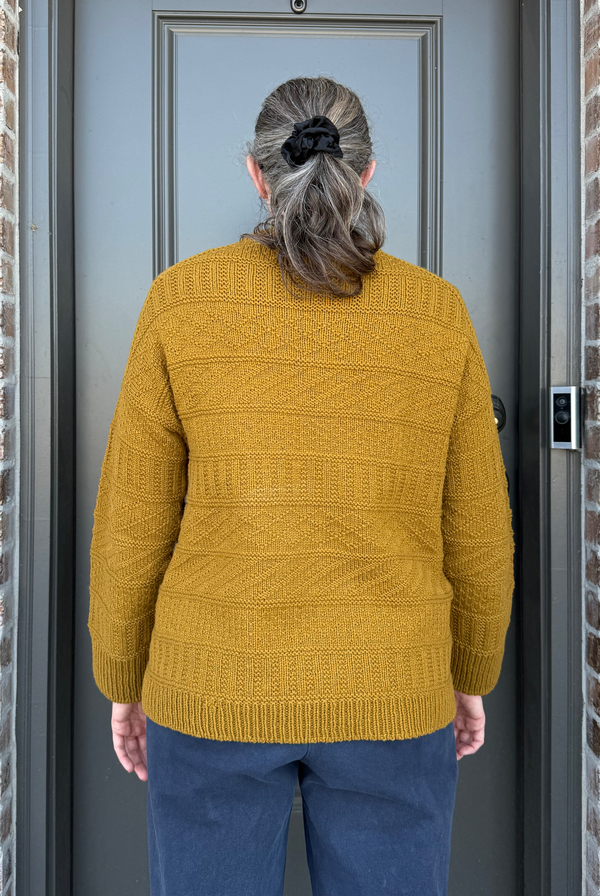
In my last blog post, I compared the men’s and women’s Mélange sweater patterns. I am doing the same here, since I found the differences between the two versions of the Storm sweater equally intriguing. I have included figures this time, so hopefully the comparison is even easier to understand, especially for those who do not knit. Here’s a link to the women’s version and men’s version of the Storm sweater.
I went back to my About page and reread Adam Savage’s quote about drawing and how “the ability to take an idea from your own mind and transfer it to the mind of another person is intoxicating.” I have always felt like my drawings are awful, but the more I challenge myself, the better they seem to get. I avoided any diagrams in my Mélange post because I did not feel skilled enough to create the figures. Then I kicked myself and said, “we can do hard things!” and just tried. I am pretty pleased with my efforts, and I hope you enjoy this post and feel motivated to try hard things too.
Style and Fit
Like the Mélange sweater, the Storm Sweater uses the same overall construction in both the men’s and women’s patterns, even though the final fit differs. The sweater is worked from the top down. The back yoke is shaped with short rows, which raises the back neckline and creates the shoulder slope. The shoulders are worked flat and then joined to form the front yoke.
The Storm Sweater has dropped shoulders, meaning the shoulder seam extends past the edge of the shoulder for a relaxed silhouette. The front neckline is lower than the back, creating a classic jewel neckline. Once the yoke is complete, the body and sleeves are worked in the round. The sleeves are picked up and knit from the armholes, resulting in a seamless finish. The neckline is finished with a folded double rib.
Sizing
My bust measures between 39 and 40 inches. I typically knit a size L in PetiteKnit patterns. When I knit the Mélange sweater, I sized up, so I initially did the same for the Storm Sweater. After starting the project, I realized the larger size was not the right choice for me. I frogged and restarted in my usual size L.
Details
The pattern recommends using 800 g of Peer Gynt by Sandnes Garn (50 g = 91 m), which works out to roughly 1,456 m of yarn total. Peer Gynt is 100% Norwegian wool, and I have absolutely no experience with that type of yarn. I still have nightmares of an L.L.Bean wool sweater I owned in the 1990s. It was itchy, scratchy, uncomfortable, and always left me with a runny, stuffed up nose from allergies. Sandnes Garn does have a superwash version of Peer Gynt called Smart, but I still was scared.
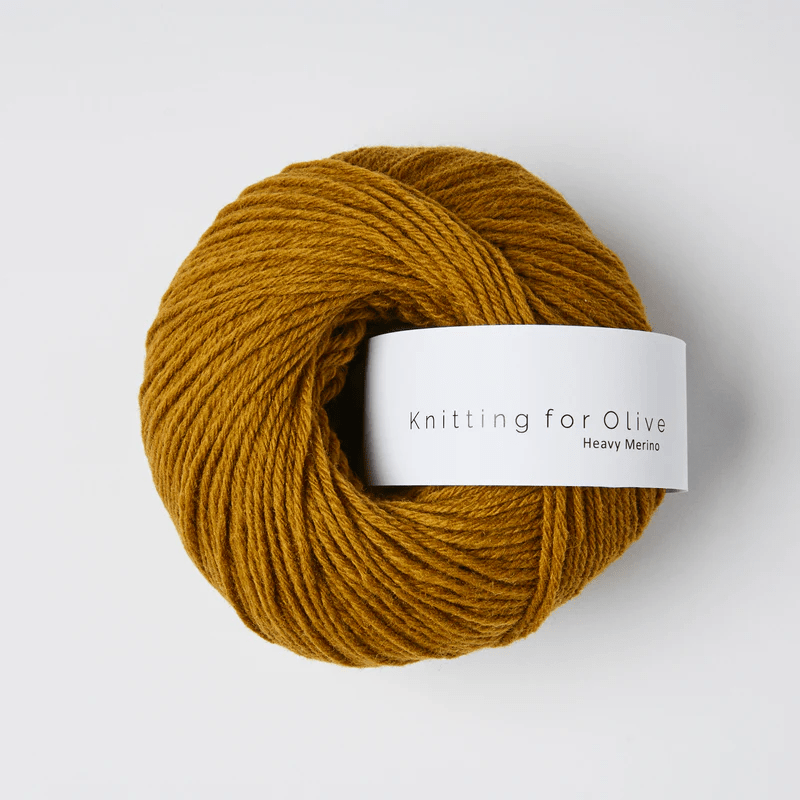
I was not ready to commit to an entire sweater made from a yarn I might dislike, or worse, be allergic to. Instead, I chose my preferred alternative from Knitting for Olive and went with Heavy Merino in Dark Ocher. Knitting for Olive Heavy Merino is 100% merino wool (50 g = 125 m).
I would not say the Knitting for Olive yarn and the Sandnes Garn yarn are directly comparable, but they are close enough for this pattern. I ended up using 11.4 donut balls of Knitting for Olive Heavy Merino, which comes to approximately 570 g or 1,425 m of yarn.
Because my yarn choice differed from the recommended yarn, it was important to check gauge throughout the project. The pattern recommends:
- Needles: 4 mm [US6] needles
- Gauge (after washing and blocking): 20 sts x 32 rows = 10 x 10 cm [4 x 4 inches] in texture pattern
I was able to get very close to gauge, but I needed to go down two needle sizes:
- Needles: 3.5 mm [US4] needles
- Gauge (after washing and blocking): 21 sts x 32 rows = 10 x 10 cm [4 x 4 inches] in texture pattern
Men’s vs. Women’s Patterns
Since comparing the men and women’s Melange pattern, I’m curious if the same difference exist with this pattern. Below is a comparison of the Women’s L against the Men’s L, broken down by construction stage.
Intended Ease
The two sweaters are designed with very different silhouettes in mind.
- Women’s version: 26 cm (10-1/4 inches) of positive ease in the smaller sizes, with gradually less positive ease in the larger sizes.
- Men’s version: 10 to 15 cm (4 to 6 inches) of positive ease in the smaller sizes, with gradually less positive ease in the larger sizes.
Overall Length
Measured mid back, excluding the neck edge:
- Women’s size L length: 62 cm (24-1/2 inches).
- Men’s size L length: 72 cm (28-1/4 inches).
That is nearly 4 inches of extra length in the torso alone.
Back Yoke
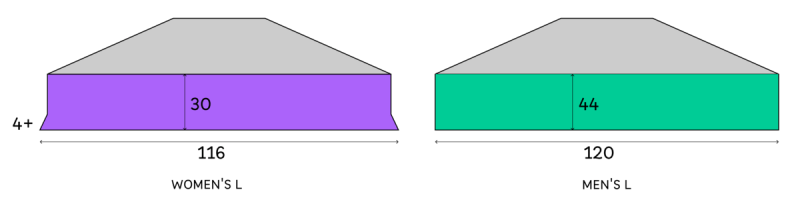
The women’s version starts with narrower shoulders and then adds width early through the yoke to make room for the bust. The men’s version has wider shoulders and keeps the yoke straighter, which reduces bulk across the upper chest and back. Overall, the men’s back yoke is also longer, with 19 additional rows (5 short rows and 14 after the short rows). Let’s look more closely at the details:

Cast-on stitches:
- Women’s L: 112 (40 for each shoulder, 32 for back neckline)
- Men’s L: 120 (44 for each shoulder, 32 for back neckline)
Armhole shaping:
- Women’s L: Increases 4 stitches (2 on either side) during the yoke
- Men’s L: None
Total number of stitches on the needle when the yarn is broken and the stitches are set aside while the shoulders and front yoke are worked:
- Women’s L: 116
- Men’s L: 120
Shoulders
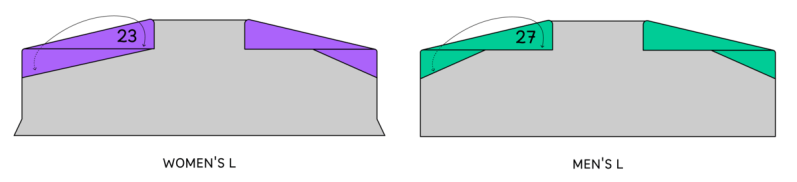
Picked up stitches:
- Women’s L: 40
- Men’s L: 44
The men’s sweater works four additional rows before neckline increases begin. This differs from the Mélange sweater, where the women’s version worked more rows before neckline shaping.
Rows worked before neckline increases:
- Women’s L: 23
- Men’s L: 27
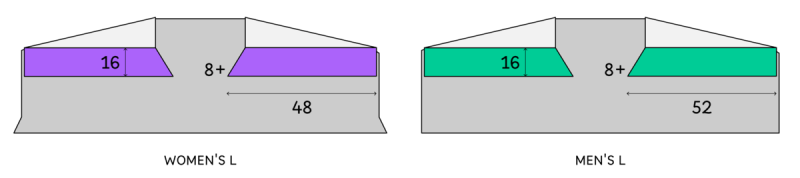
All sizes work eight neckline increases across 16 rows. Stitches after increases:
- Women’s L: 48
- Men’s L: 52
Front Yoke
As with the back yoke, there is armhole shaping only in the women’s version, and the front yoke is longer in the men’s version by 10 rows (4 along the shoulder and 6 after the neck hole).
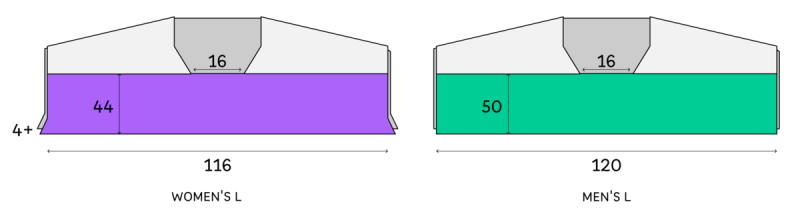
The right and left shoulders are joined to form the front yoke, while new stitches are cast on between them to form the front of the neck.
- Women’s L: 16 (112 sts total on the needle)
- Men’s L: 16 (120 sts total on the needle)
Total stitches after the chart is worked:
- Women’s L: 116
- Men’s L: 120
Body
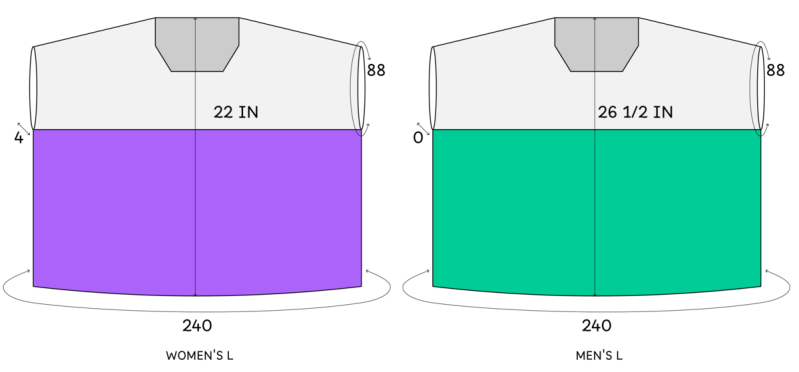
Underarm stitches cast on:
- Women’s L: 4
- Men’s L: 0
Total number of stitches after joining in the round:
- Women’s L: 240
- Men’s L: 240
Body length (mid back, excluding neck edge):
- Women’s L: 22 in
- Men’s L: 26-1/2 in
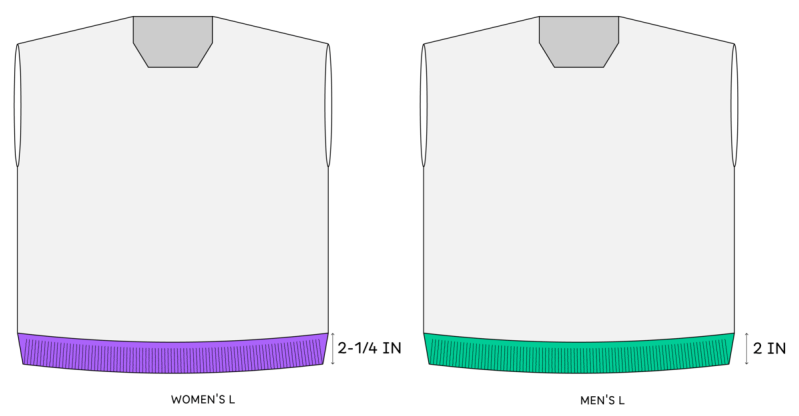
Ribbing length:
- Women’s L: 2-1/4 in
- Men’s L: 2 in
Sleeves
The men’s sleeve has more frequent decreases and results in a more fitted sleeve. The women’s sleeve is oversized in comparison.
Picked up stitches:
- Women’s L: 88
- Men’s L: 88
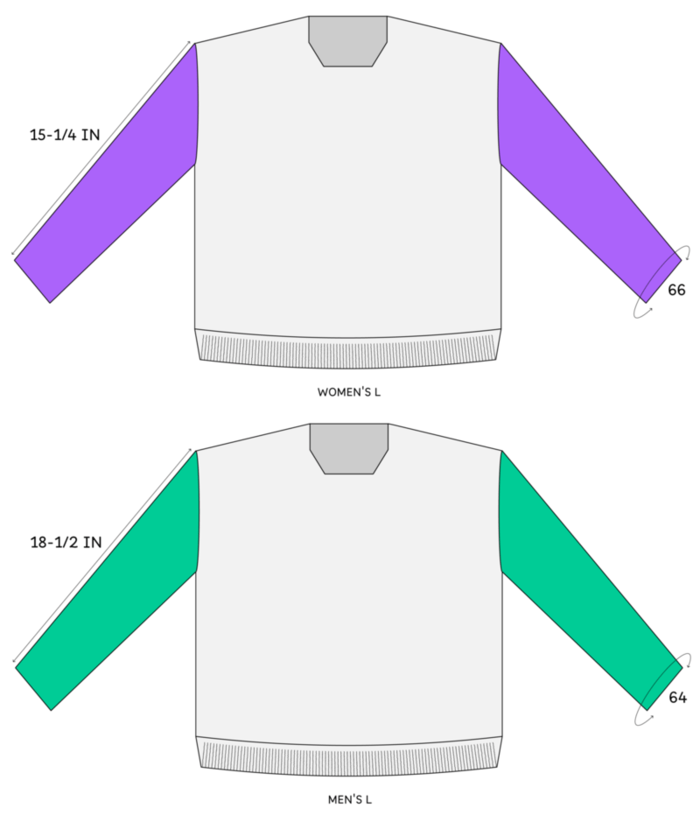
Decreases are worked along the length of the sleeve. The total of number of stitches at the end of the sleeve:
- Women’s L: 68
- Men’s L: 64
Continue knitting the chart pattern without decreases until the sleeve measures:
- Women’s L: 15-1/4 inches
- Men’s L: 18-1/2 inches
The women’s pattern then reduces the stitch count to 66 before starting the cuff. This reduction is not done in the men’s pattern.
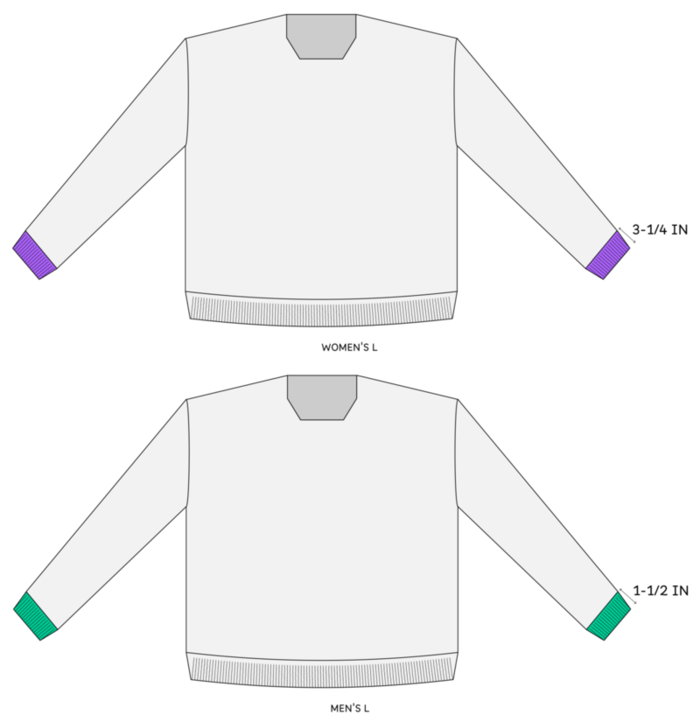
Cuff ribbing length:
- Women’s L: 3-1/4 inches
- Men’s L: 1-1/2 inches
Neck Edge
The women’s neckline is wider, deeper, and visually softer. The men’s neckline sits closer to the neck, is shallower, and feels more compact and classic.
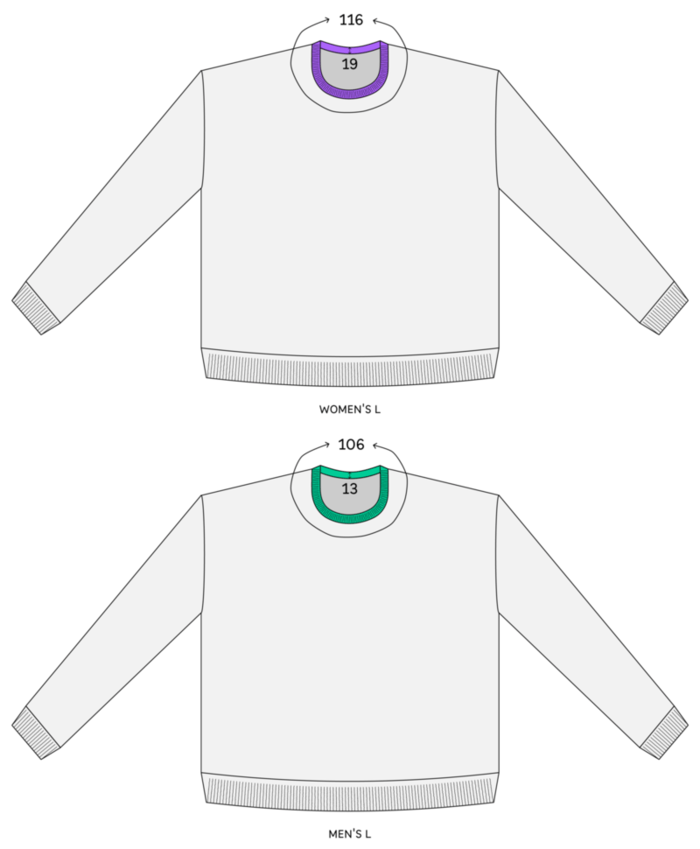
Picked up stitches:
- Women’s L: 116
- Men’s L: 106
The instructions for picking up stitches:
- Women’s L: “This is approx. equivalent to picking up and knitting 1 stitch in every stitch along the back of the neck, along the front and along the slanting sides, while 2 sts are picked up for every 3 rows along the straight sides.”
- Men’s L: “This is approx. equivalent to picking up and knitting 1 stitch in every stitch along the back of the neck and along the front, while 3 sts are picked up for every 4 rows along the straight sides and the slanting sides.”
Rounds for folded double rib:
- Women’s L: 19
- Men’s L: 13
What this tells us
When I first thought about how men’s and women’s versions of a knitting pattern might differ, I expected them to look very much like the Storm Sweater. I assumed the men’s version would begin with wider shoulders and add very little width through the yoke, while the women’s version would start with narrower shoulders and then introduce shaping in the yoke to make room for the bust. The arm and body circumference would end up being similar in both versions, but the men’s sweater would be longer overall. The differences would not be about total size, but about where the fabric is placed and how the shape is built.
What I find confusing now is why the Mélange sweater does not approach men’s versus women’s fit in the same way.
A note on measurements in this section: All measurements in this section are derived from my own calculations. I extracted the number of rows from the pattern instructions and converted them to inches using the stated stitch gauge. Lengths and circumferences are therefore estimates based on row and stitch counts, not measurements taken from a finished garment. Any errors in row counting or interpretation of the instructions would directly affect these values.
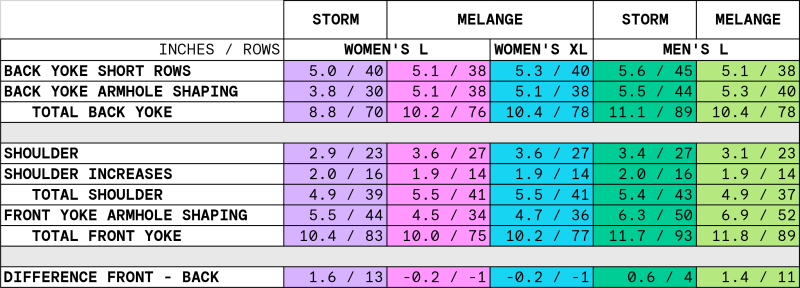
When I compare the Storm and Mélange patterns for women’s and men’s, it becomes clear that the shaping logic is not consistent across the two designs. Based on the Storm Sweater, I would have expected the following to hold true in both patterns:
- The men’s front and back yoke would be longer overall than the women’s.
- The difference between the women’s front and back yoke would be greater, to accommodate the bust.
This holds true for the Storm Sweater. For women’s size L, the front and back yoke measure 10.4 and 8.8 inches. For men’s size L, they measure 11.7 and 11.1 inches. The difference between front and back is 1.6 inches for women and 0.6 inches for men. In other words, the men’s yoke is longer overall, while the women’s yoke has a larger front-to-back difference to accommodate the bust.
When I look at the Mélange sweater, however, this logic breaks down. The women’s front and back yoke measure 10.2 and 10.0 inches, while the men’s measure 10.4 and 11.8 inches. The resulting front-to-back difference is effectively zero for women, at –0.2 inches, and much larger for men, at 1.4 inches. At this point, I’m scratching my head. A negative front-to-back difference for the women’s yoke does not intuitively make sense, since the front must travel over the shoulders and down the chest, and would always need to be longer than the back.
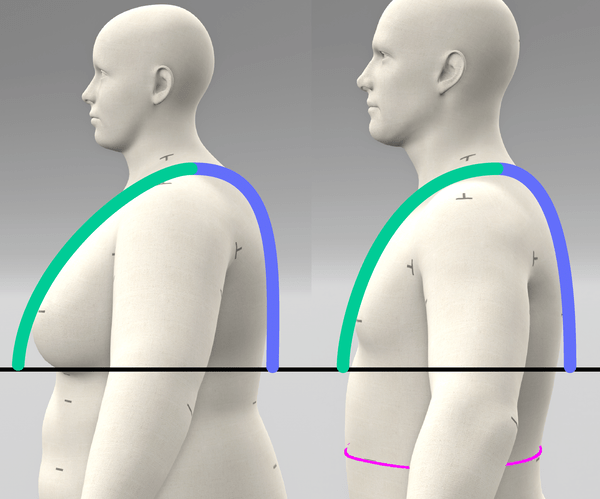
Looking at the image above, the back yoke (blue) sits behind the shoulder point, while the front yoke (green) has to travel over the shoulders and down the front of the body. In both avatars, the front yoke is longer than the back. You can also see that the presence of breast tissue requires additional length in the front yoke to allow the sweater to hang correctly. Hanging correctly means that, once worn, the front and back yoke land on the same horizontal plane rather than the front being pulled upward or the back being pushed downward.
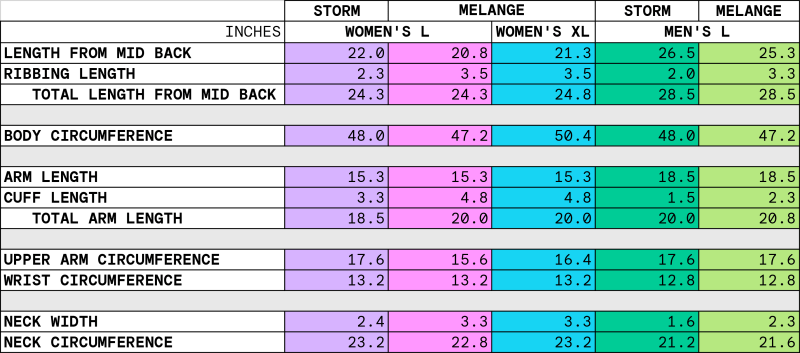
There are aspects of the sizing that do make sense. The total length measured from mid back is the same across patterns, at 24.3 inches for women and 28.5 inches for men. Arm length, however, is more variable. For women, the Storm sleeve measures 18.5 inches, while the Mélange sleeve measures 20 inches. The men’s sleeves are more consistent, measuring 20 inches in the Storm and 20.8 inches in the Mélange.
Aside from these yoke and sleeve differences, the rest of the measurements behave as expected. Body, wrist, and neck circumference all scale in ways that make sense and feel consistent between the two patterns. The women’s neck circumference is a bit larger, approximately 23 inches, whereas the men’s neck circumference is a bit smaller and tighter, 21 to 21.5 inches.
Final Fit Deep Dive
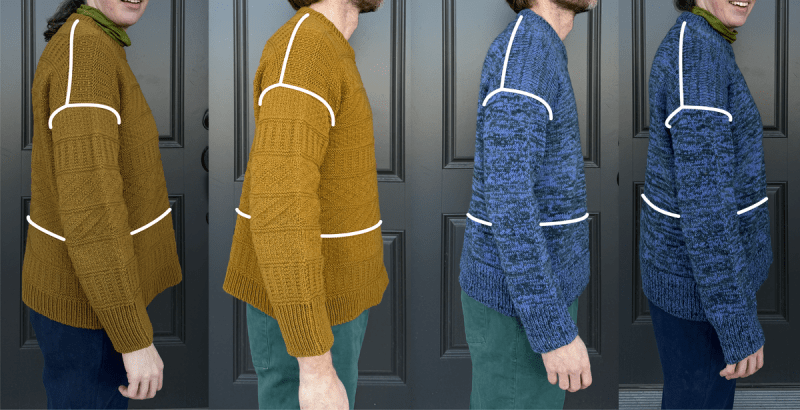
We can clearly see the impact of yoke length in the images above. The Storm sweater is shown in ochre, and the Mélange sweater in blue.
The yoke of the ochre Storm sweater is not long enough for Ryan. This shows up in the shoulder seam placement, which is being pulled forward aggressively and not sitting relaxed on the back of his shoulder. As a result, the entire back of the sweater is lifted upward. I have added balance lines at the waist to make this easier to see. The back hem is no longer parallel to the floor, indicating that the sweater is out of balance.
By contrast, when I wear the Storm sweater, the shoulder seam sits relaxed and straight across the back of my shoulders. Looking at the front balance on me, however, the ochre sweater show a slight upward pull at the front. I don’t think this is because the front yoke is too short, but because additional fabric is needed to travel over the bust. Few sweater patterns explicitly account for this. Since the sweater appears balanced above the chest, the unbalanced front hem is more likely due to the presence of bust volume rather than insufficient yoke length.
Conclusions
What I ultimately learned from this comparison is that you cannot make assumptions about fit from one pattern based on another, even when they come from the same designer and share similar construction. Each pattern has its own shaping logic and fit priorities. Understanding how a sweater will fit requires looking closely at where length and width are placed, not just at finished measurements or design similarities.
One of the ongoing frustrations of knitting is that the only truly reliable way to know how a sweater will fit is to knit it. Sweaters are expensive, time-consuming, and represent many hours of work, which makes fit decisions feel high-stakes. I would love a more systematic way to study pattern design and predict fit before committing to a full project. This post was my attempt to unpack some of that mystery by examining construction details and asking why patterns that look similar on the surface can behave so differently when worn.
It is also worth saying that no amount of analysis replaces trying a sweater on as you knit it. Checking fit early and often is essential, especially for top-down sweaters. I am also not shy about washing and blocking mid-project. My preferred approach is to knit the yoke, a few inches of the body, add the neckline, and begin the sleeves, then wash and block the sweater before committing to the full body and sleeves. Taking the time to do this makes it much easier to catch fit issues while they are still easy to fix. I have frogged many sweaters at this point. It is never fun, but I would much rather frog a sweater halfway through than finish one that does not fit.
Personal Aside
All of my free time lately has been eaten up supporting my in-laws with the unexpected loss of Ryan’s sister in January. On top of that, I’ve been doing some serious digital house cleaning for my parents, who have completely mentally checked out from trying to use any technology. In the process, I discovered several absolute lifesaver apps.
No, I have not been taken over by pod people or been abducted by body snatchers. These aren’t advertisements—just me sharing my experiences as I’m learning to navigate the stress of taking care of aging parents. It’s a lesson we are learning with Michelle’s passing: she had all her physical stuff managed, but the digital legacy was an afterthought.
Proton Pass
My parents were notoriously resistant to password managers—they didn’t even know this kind of tech existed. They were living in a security nightmare: using the same credentials for everything, with 40+ pages of hand-written notes and a rat’s nest of unsynced logins saved across various browsers and mobile devices.
We finally hit a breaking point. I moved everything into Proton Pass and I couldn’t be happier! Forget 1Password or Bitwarden; this has been the most seamless experience across PC and Mac, and it’s officially “80+ year-old approved.” The best part is that everything can be securely stored: usernames, passwords, emails, 2FA (security) codes, passkeys, and backup codes.
I’ve found that Firefox is the best browser for running it smoothly between their PC desktops and their iPhones. I am paying for a Proton Pass Family account and added them as members. They have their own vaults, but because I’ve shared their personal vaults with me when I set up everything, I can jump in and fix things when they’re struggling. Adding their credentials one by one allowed me to do a mix of KonMari (keeping only what’s functional) and Swedish Death Cleaning (organizing so I’m not left with a bigger mess later). My parents have lost several hundreds of dollars lately to PayPal scams, fake AI online stores, bogus App Store subscriptions; trust me, minimizing and securing their digital life was critical.
Cleaning up the Internet and Avoiding Rabbit Holes
A couple of things about Firefox have been helpful. First, I have them signed in so their bookmarks and history sync across devices. To avoid those fake AI stores, I just bookmark the real sites they like so they can go there directly. I can also see their browser history to tell when they’re struggling so I can reach out and ask if they need help. Just yesterday, they couldn’t figure out how to pay and I was able to see their shopping cart and complete the order myself. Boom!
I’ve also added two critical “extensions” (add-ons) to their browser:
- uBlock Origin: This is just essential to slow down the pop-ups, newsletter notifications, and cookie requests.
- UnHook: I’ve added my parents to our Family YouTube account to minimize the junk pushed to them, but UnHook cleans up the rest. It hides related videos, “Shorts,” comments, and homepage recommendations. I know it’s enticing to watch salacious videos that are only there to agitate and goad, so anything I can do to prevent that rabbit hole is good.
Along those same lines, I’ve moved them away from Google to Kagi for searches and news. Kagi news is “boringly fantastic,” and the search is how Google used to behave in the early days. Again, I’m paying for a family account and I’ve added my parents to the family. At this point, I will do anything to get my parents off their computers and away from toxicity, so they can do things they enjoy! Puscifer’s new album released this month and the lyrics are so good. I think this sums up what I’m trying to prevent, “stuck in a loop of tunnel vision paranoia”.
Folge.me
Since the whole concept of “autofill” is foreign to them—and because I basically staged a digital intervention—I needed a way to show them exactly how to navigate their new reality.
Think about it from their perspective: I took away all their handwritten notes, deactivated their social media, changed their browser, and wiped every unnecessary app off their phones. I essentially moved them into a brand-new house and changed all the locks. To make sure they didn’t feel totally lost, I started using Folge.me.

Folge is a documentation tool that captures my screen as I click, automatically turning my actions into step-by-step guides with screenshots. By using it alongside Mac’s iPhone Mirroring, I can even include steps for grabbing those 2FA security codes from their text messages, because they don’t know what to do with those numbers they receive…sigh!
I’ve whipped up over a dozen custom guides in just two weeks—everything from logging into Medicare and Social Security to navigating MyChart and their banks. My parents have no problem following instructions when they are laid out clearly with pictures, and Folge makes creating those guides nearly instantaneous. It’s the only way to ensure this “Digital Death Cleaning” actually sticks. Otherwise, my dad was planning to take all his devices over to the shooting range and use up some of the bullets he’s been making for his old Winchester. I don’t think he was joking.
Clot Anniversary
Besides that, I’ve got nothing more exciting to report than being happy to celebrate my 2-year clot anniversary! January and February have been tough, and I’m just glad things are finally starting to calm down a bit. To quote the late, great Terry Pratchett, a near-death experience inescapably means that Death has to undergo a “near-me” experience. Thankfully, Death hasn’t had any more “near-me” experiences. The fear of re-clotting is always there…

“with gradually less positive ease in the larger sizes.”. That is SO heinous. Stupid pipsqueak idea of trying to erase the existence of fat people. When I see a picture of a pattern, I want to make THAT, not some sausage-like vaguely resembling version. Ease ought to be proportional, basically a percentage of the body measurements. Sheesh.
I’m getting convinced that sweater making should start by perfecting a sweatshirt pattern, and then knitting to reproduce that as closely as possible. There’s no magical way to address fit issues in knits.
That said, very sorry to hear about the loss of Ryan’s sister. I’m sure his parents are in need of much support, besides coping with your own feelings. Thanks for the good parental e-advice, I’m afraid there’s lots of that sort of disorganization in many cases. I myself took advantage of transcontinental moving to drag my girlfriend into Bitwarden with a common vault and it’s been a lifesaver. Love the easy documentation recommendation too, I’m sure that’ll come in handy. Thanks again for this very solid set of recommendations that everyone should address before they really need to..
It annoys me that I can’t easily filter by size made on Ravelry’s projects. The women’s Storm sweater has been completed 2,271 times, but I’m not going to scroll through 62 pages. If the maker included the size in their post, I can type in “5XL” in the search bar and see some of the versions. Let me know if I should use my new Folge.me skills and create a post about how to do a deep dive search on Ravelry!