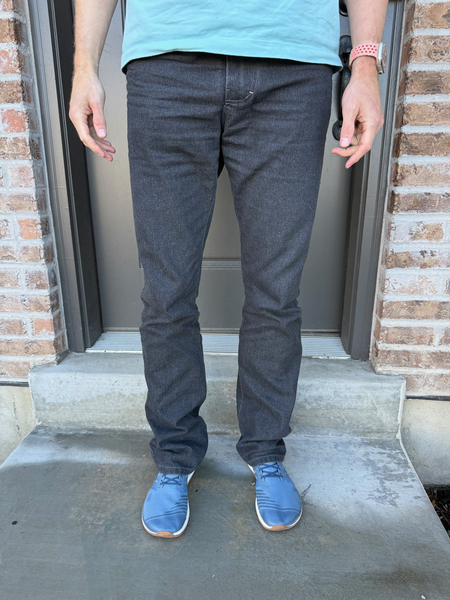
Ryan has desperately needed new jeans for several years now—not because his jeans didn’t fit or were too old, but because even after prewashing the fabric, they still shrank significantly lengthwise over time. Annoyingly, his jeans ended up several inches too short and looked ridiculous. Unfortunately, I didn’t have enough fabric leftover to add panels to the bottom to lengthen them (similar to the Shop Pants pattern). I just couldn’t take his high-waters any longer.
I’ve never used an actual pattern to make Ryan’s pants; they’ve always been self-drafted because of his unique shape. However, on a whim, I decided to try a commercial pattern. I was torn between the Fulford Jeans from Thread Theory Designs and the Wardrobe By Me (WBM) Men’s Jeans. I went with the WBM because I didn’t want to deal with the straight side seam of the Fulford Jeans—only to discover that the WBM also has a straight side seam. I decided, what the heck, let’s try the pattern anyway. If it turned out awful, my backup plan would be the Morgan Jeans from Closet Core Patterns.
I knew that whichever pattern I ended up using, I would need to include a front dart, and I was planning on using the construction method from the Stokx Pattern Square Pants. However, when I discovered the hidden front dart integrated into the front pocket construction, I was beyond excited. By lucky coincidence, the WBM Men’s Jeans ended up being perfect for Ryan.
I’ve already hinted at this pattern in my last two posts. If you want to read more about my deep dive into bespoke buttonholes, check out that post here. And if you haven’t yet, take a look at my post about front darts here.
Analyzing Style and Fit
On the surface, these look like your classic five-pocket design with a straight, relaxed fit and boot-cut legs. But this pattern has two hidden features that make it absolutely brilliant: straight side seams so you can make the jeans from selvedge denim, and a hidden front dart.
Besides the unique pattern drafting, the jeans come in 15 sizes ranging from 26 to 42 inch waist and 32 to 48 inch hips. Using VStitcher, I rendered the jeans on Oliver in size 34 (34 inch waist, 40 inch hips) across multiple body variations (lean, average muscle, ripped, and belly). The fabric is 8.25 ounce denim (95% cotton and 5% recycled cotton) for realistic drape. To highlight fit, I’ve added drapelines and balance lines as references. The fit of the jeans changes dramatically with the different body types. At the end of the video, I show what would happen if you removed the hidden front pocket dart.
Sizing

Ryan’s current measurements are a 33-inch natural waist and a 41-inch lower torso. The pattern recommends choosing your size based on the waist, but I ignored that and went with the lower torso measurement instead. I made a size 35 for Ryan. I’m glad I did, because the jeans were extremely tight in places at first. Once the waistband was fitted to Ryan’s preferred position, his waistline measured 35.5 inches. However, according to the pattern’s final garment chart, the waistband for size 35 should measure 36.25 inches, which makes me think the pattern drafting might be slightly off.

The final garment chart in the PDF (waistband and hips column) is shown on the left. When I measured from the center of the button to the edge of the buttonhole, I got slightly smaller waistband circumferences across all sizes—about 3/4 inch smaller on average (waistband difference column). For the hip, I measured at the top of the crotch curve, which is where I usually take the widest torso measurement. My results showed the hip measurement getting progressively smaller as the sizes increased (hip difference column).
Now, the hip discrepancy could simply come down to where the measurement is taken. Without a clearly marked hip line on the pattern, there’s no way to know exactly where the designer placed their reference point. But the waistband difference is harder to explain since I measured directly from the button to the buttonhole.
Materials
I made one of those impulsive buys without ordering a sample first. I was hoping to find a denim supplier I could count on long term. This is Etta Washed Denim (100% cotton, 40 g/m2) from mind the MAKER that I bought through Minerva. I really dislike those niche fabrics that disappear after one run. When I bought the upcycle denim a few years ago, it seemed like it would stick around since it was sold everywhere—We Are The Fabric Store, Closet Core, Blackbird, and others. Turns out it was more of a one-time thing. The Etta Washed denim itself is fine, just softer than I expected, which makes the jeans baggy by the end of the day.
I recently stumbled across a new-to-me online fabric store that completely blew my mind. One of my biggest pet peeves is how seasonal fabrics only ever show up in that season’s color palette. Take corduroy, for example—it’s always tied to autumn, which means you mostly see it in deep, rich shades like emerald green, plum, brick red, burnt orange, and mustard. That’s great if I’m sewing for myself, but Ryan looks best in a soft summer palette. Good luck finding corduroy in muted or grayish browns, greens, blues, and purples! Ryan’s favorite pants growing up were a pair of taupe gray corduroys, and now that I’ve found corduroy in so many colors, I think I might have to make him another pair of jeans!
Finding the Drapeline
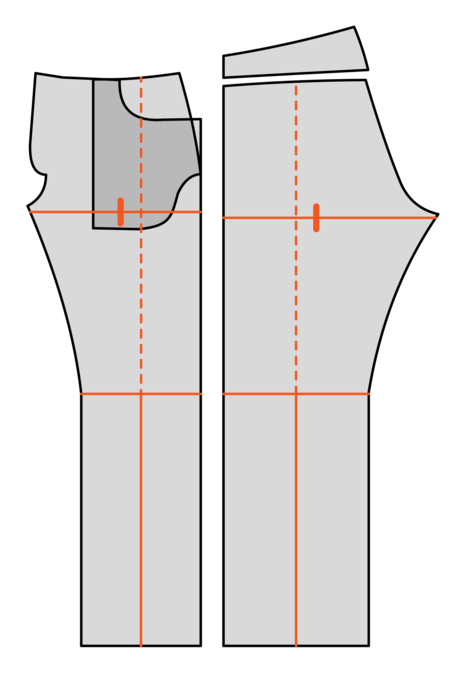
With patterns that have a straight side seam or no side seam, you can locate the drapeline by marking the midpoint of the front hem and the midpoint of the knee. Normally, connecting those two points gives you a line you can extend up to the waistline to form the full drapeline. However, this particular pattern is a little different because of its bootcut shape. The hem and knee centers line up vertically, which means your drapeline would end up parallel to the selvedge edge—and that doesn’t make sense from a draping perspective.

If you want to know where the drapeline goes from the knee up to the waistline, you’ll need to make a mockup pair of jeans and using my laser level method, draw a line where the laser level crosses the horizontal crotch level. Then connect the midpoint of the knee to your laser level mark, continuing that line all the way up to the waistline.

That said, this step isn’t really necessary. You can’t adjust the drapeline on a straight side seam the same way you can on a contoured side seam. With straight or no side seams, every change has a trade-off and there are other ways to fit pants with a straight-side seam. Let’s break this down.
Adjusting Torso Circumference

Here I’m showing how to increase circumference, but if you need to decrease it, you’d make the same adjustment in reverse—removing fabric instead of adding it. To maintain a straight side seam, you have to add fabric evenly from the waistline all the way down to the hem, even if you only need extra room in the torso. This widens the pant leg and shifts the drapeline, which is the trade-off. On a contoured pattern piece, by contrast, you can add fabric only where it’s needed—above the horizontal crotchline—while keeping the grainline fixed and the pant leg width unchanged.

You can’t just add extra room at the side seam on a straight side seam pattern, because that would make the seam no longer straight. (Try saying that three times fast.) Similarly, you wouldn’t add fabric all along the side seam on a contoured pattern either. Doing that would widen the pant leg, shift the drapeline, and throw the whole pattern off balance.
Adjusting Leg Width

If you want to widen the leg circumference on a straight side seam pattern, add fabric only to the inseam. This causes the drapeline to shift, as you’ll see in the next example.
For a contoured pattern, add the same amount to both the inseam and the outseam. Uneven adjustments make the pant leg twist when worn. When you add fabric evenly, the drapeline stays in place. When you add it to just one side, the drapeline shifts, which is what causes the twist.

You don’t want to widen the pant leg along the side seam on a straight pattern, because doing so either breaks the straight side seam or, if you carry the adjustment all the way to the waistline, changes the torso width instead.
On a contoured pattern, widening only one side of the pant leg throws off the balance.
Adjusting Drapeline Placement

As hinted above, widening the pant leg moves the drapeline closer to the center front. This is how you would move the drapeline.
To create that same shift on a contoured pattern, you’d cut across the horizontal crotch line, move the torso section over to where the new drapeline needs to be, and then redraw the legs from the crotch line down to the knee line. I go through this alterations in more detail in my eBook. You are only adjusting the drapeline placement and not having to change circumference of anything.

You wouldn’t adjust the drapeline on a straight side seam pattern by shifting the torso, because that would eliminate the straight side seam. And you wouldn’t move the drapeline on a contoured pattern by adding only to the inseam, because that would widen the entire leg.
Hopefully now it makes more sense why I say drapeline placement on a straight or no side seam pattern isn’t all that helpful. Any change you make—whether it’s increasing or decreasing the torso width or adjusting the leg width—automatically shifts the drapeline.
It’s better to focus on getting the circumferences right for your body and accept that you won’t get quite the same level of precision in fit, since the straight side seam limits what you can adjust.
And if you want your straight side seam pants to drape differently, consider adjusting waistline placement. In Chapter 8 of my eBook, I go over waistline placement in detail.
Checking Balance
I cover pant balance in my YouTube video, but here’s a quick overview. Start by aligning the outseams at the hem. Check that the side seams match in shape from the hem to the knee, the tops of the side seams align, and the drapelines stay parallel.
Then align the inseams. Make sure they match from the hem to the knee and that the tops are nearly level—the back can sit up to 3/8 inch lower. Finally, compare the inseam lengths. They should be the same, though the back inseam can be up to 3/8 inch shorter.
The WBM men’s jeans pass this check and are balanced.
Alterations
Front and Back

I added 1-1/2 inches to the front rise, widened the side seam by 1/4 inch, and lengthened the pants by 5 inches. Ryan doesn’t actually need the full 5 inches, but I’m not taking any chances after the last pair shrank in the wash. This time, I prewashed the denim twice in scorching hot water and dried it on high heat, so hopefully it won’t shrink any further. In a few months, I’ll rehem the pants to a more reasonable length.

I added 1-1/2 inches to the back side seam but kept the center back height the same. I also added 1-1/4 inches to the center back seam. On top of that, I removed 3/8 inch from the side seam and added 5 inches in length.
Contouring the Back Yoke

The original back yoke didn’t have much shaping, so I needed to completely alter it for Ryan.

To do this, I made a cut from the top of the yoke almost all the way down to the bottom, then overlapped the pieces by 3/4 inch.

Once the lines were smoothed out, the result was a more contoured back yoke.

After that adjustment, I widened the center back by 1-3/8 inches and added 3/8 inch to the top of the side seam.
Final Fit
I ended up making two pairs of jeans—one in black and one in dark blue. Here’s Ryan at the end of the day wearing the black pair. And yes, I know those extra five inches in length might never get rehemmed. Ryan’s never had jeans this long in his life!


Here are a few detail shots of the hand stitching I did. I had to redo the waistband on Ryan’s dark blue jeans, which meant that beautiful bespoke buttonhole had to be completely restitched. Honestly, I think the second version turned out even better than the first.

I also added bartacks to the pockets and fly—if I can hand-sew a buttonhole, I can definitely handle a few bartacks.

And of course, a gratuitous shot of the pretty inside pockets and waistband.
Personal Aside
While I was putting this post together, I was trying to decide what personal aside to include. I thought about mentioning a few recent fitness milestones (like running my first half marathon) or teasing my next big project (a framed backpack with a hip belt). But then Adam Savage dropped this fantastic video about sewing your own inflatable costumes!
They never mention the fabric company by name in the video, but I know for a fact you can custom print any color or design on Silpoly at Ripstop By the Roll.
Adam could barely contain his excitement throughout the video, and Megan and Taylor were just as thrilled to talk about their costumes. The whole thing is 48 minutes of pure joy, excitement, and fun. I was smiling the whole time watching.

IF YOU FOUND THIS POST HELPFUL, CONSIDER SUPPORTING MY WORK BY SIGNING UP FOR A PAID SUBSCRIPTION.
POSTS OLDER THAN 3 MONTHS ARE NOW FOR SUBSCRIBERS ONLY — YOUR SUPPORT KEEPS THIS SPACE GOING.
INTERESTED IN SUBSCRIBING TO RECEIVE NEW POSTS IN YOUR INBOX?


Leave a comment