To the extent that we believe we can skip steps, avoid the process, magically gain power through political connections or easy formulas, or depend on our natural talents, we move against this grain and reverse our natural powers. We become slaves to time—as it passes, we grow weaker, less capable, trapped in some dead-end career. We become captive to the opinions and fears of others. Rather than the mind connecting us to reality, we become disconnected and locked in a narrow chamber of thought. The human that depended on focused attention for its survival now becomes the distracted scanning animal, unable to think in depth, yet unable to depend on instincts.
It is the height of stupidity to believe that in the course of your short life, your few decades of consciousness, you can somehow rewire the configurations of your brain through technology and wishful thinking, over-coming the effect of six million years of development. To go against the grain might bring temporary distraction, but time will mercilessly expose your weakness and impatience.
– Robert Greene, Mastery (Introduction)
I’ve been thinking a lot about attention, algorithms, and what it really takes to learn a new skill—especially after reading Doppelganger by Naomi Klein, The Chaos Machine by Max Fisher, and Trick Mirror by Jia Tolentino. All three explore how our minds, habits, and culture are being shaped by technology and capitalism in ways that often work against our deeper interests. I highly recommend all three.
These ideas collided with my own learning journey in my sewing space—specifically, trying to master a proper, hand-worked buttonhole. Through this process, I’ve realized a hard truth: social media feeds aren’t making me a better sewer. Whether it’s Instagram, Facebook, Bluesky, Mastodon, or Patreon, these platforms are antithetical to deep skill development.
FOMO Stifles Creativity and Learning
That nagging feeling—I need to stay on top of trends, I’ve learned so much from that account, Where else will I find out about…—isn’t real inspiration or knowledge. It’s the stranglehold of anxiety and algorithmic addiction. Your brain is trying to justify staying stuck in the endless loop of scrolling instead of stepping into your creative space and doing the work.
Moreover, no one sews better while juggling a dozen notifications. The more fractured our attention becomes, the slower we grow as makers. We make more mistakes. We become less creative. We stop learning. I’ve recently wondered whether the phrase “online sewing community” isn’t a misnomer. True community requires shared experience and mutual growth. But how do you build that when everyone’s perpetually scrolling and reacting to content rather than actually making?
The Problem with Online Communities
The more people there are crowded into a space, the harder it becomes to thrive there. Working in such a field will tend to wear you out as you struggle to get attention, to play the political games, to win scarce resources for yourself. You spend so much time at these games that you have little time left over for true mastery. You are seduced into such fields because you see others there making a living, treading the familiar path. You are not aware of how difficult such a life can be.
– Robert Greene, Mastery (Chapter I)
Don’t get me wrong—online communities and educational content have their place. Some creators share genuinely valuable techniques. Connecting with other makers can provide real support and inspiration. But there’s a crucial difference between intentional learning and passive consumption through mindless scrolling.
Consider the absurdity of expecting to learn complex cooking techniques at a cocktail party. Or trying to master Adobe InDesign in a company-wide gathering. Large, uncontrolled groups in the real world are never about deep skill acquisition. Yet we somehow expect different results online.
Even if you got rid of algorithms and all performance metrics (follower counts, likes, shares, or any public metrics), the sheer volume of posts creates a firehose effect. Valuable information gets lost in the noise. And inevitably our biases take over and systematically favor entertaining personalities over genuine expertise. This creates a perverse incentive structure where knowledgeable people either burn out from the pressure to perform or get drowned out by flashier content. It’s no wonder so many creators trying to be noticed and successful end up succumbing to mimicking a “vibe” and trying to look like everyone else.
The result? A false meritocracy where charisma trumps competence. Quick tips dominate over fundamental principles. Visual impact overshadows technical accuracy. The most qualified experts often find their careful, nuanced explanations buried under an avalanche of hype-driven content. Instead of fostering deep comprehension and lasting understanding, online content divuldges into evangelical messaging: “Trust me, this works!” “This will change everything!” “You need to try this now!” These breathless proclamations may generate engagement, but they rarely build genuine expertise.
I’ve come to see many online sewing communities as virtual “frocktails” parties—spaces where people present curated, filtered versions of themselves. Everything is smoothed out and significantly altered to look better than reality. It’s more about showing off than building genuine communities around shared learning and skill development.
Real learning requires sustained attention. It means making mistakes, trying again, and paying close attention to the process. When you hit a wall, you’re better served by an in-depth blog post, a detailed book, or a thoughtfully paced video than a dozen “quick hack” reels engineered for engagement metrics. Zoning out on your feed isn’t the solution. Joining large groups that chatter and bombard you are just counterproductive.
Going Offline
This summer, I decided to test this theory. I shut down all my accounts—Instagram, PatternReview.com, ThreadsLoop App, Reddit, and various Patreon groups. I chose to focus fully on documenting my work on this blog only. This is my public journal and always has been. This is where I want to share my work and ideas through long-form writing, with no demand that anyone “pay attention to me NOW!” I’ve even disabled the like button—I’m not here for dopamine hits from approval metrics.
I do sometimes succumb to negative self-talk: I’m too intellectual, I’m too nerdy, nobdy likes my science approach. But I rememeber that improving my sewing skill isn’t about being flashy or charismatic. My deliberate, intellectual approach is appropriate here because I’ve always wanted sewing and making to be sustainable for me. I didn’t invest in quality tools and materials to let them gather dust.
I’ve also been releasing the fear that I would become a worse maker if I detached from the constant stream of online content. I didn’t want to be like other makers when they abandon their blogs and lean into attention-driven platforms. From there, they often take one of two paths: constantly chasing visibility and clout to stay relevant, or burning out and disappearing altogether.
It would be tedious and nearly impossible to go to a frocktail party every day, so why be on social media platforms that replicate that feeling? Sometimes you have to be alone with yourself and do the work. It can feel scary going it alone, but that’s where real skill development happens. That’s where you build the sustained attention that deep learning requires. The algorithms want us to believe we’ll miss out if we step away. But what we’re really missing is the chance to develop genuine expertise, to sit with difficulty, and to grow through focused practice rather than endless consumption. This is my invitation to try something different. To trust your own skills, knowledge, and problem-solving abilities.
Buttonholes
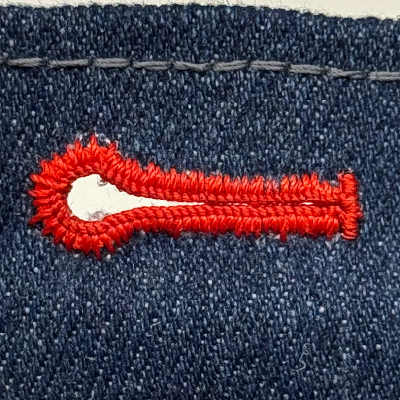
Which brings me to my latest deep dive: buttonholes. I recently made Ryan a fabulous pair of jeans (more on that in a later post), and I wanted to make them special. So I committed to learning how to hand-sew the buttonhole—a genuinely challenging task. There’s no room for error, since the buttonhole is typically the last element added once the garment is finished, requiring precise cutting and stitching.
Making a buttonhole by hand was never going to be solved by a flashy “10 hacks” video. What I needed was foundational understanding—something that can’t be compressed into a 60-second clip. Real craft knowledge is inherently demanding, because it requires muscle memory, spatial reasoning, and deep intuitive understanding that only develops through repetition, failure, and patience. And yes, plenty of sleep too.
Neuroscience sidenote: muscle memory actually improves during sleep, specifically during REM stages when your brain’s neurons rehearse the motor tasks you learned during the day. When you wake up the next morning, you’re genuinely better at those movements because your brain spent the night consolidating what you learned. This is why sleep helps you nail that difficult piano piece, why your needle control improves, why complex hand movements become more fluid over time. I was actually in the room when Lynn Nadel first reported his groundbreaking discovery about hippocampus cells firing and rehearsing during sleep. His whole presentation was: ‘NAPS MAKE YOU SMARTER!’ and then he sat back down.
When we promise people that everything should be “easy,” we’re fundamentally misrepresenting what skill acquisition looks like. In doing so, we risk devaluing real expertise and the satisfaction that comes from earned competence.
The Journey
So here’s what I want to share: the journey of learning this one specific skill. I’ll walk you through the resources that actually helped (spoiler: they weren’t bite-sized content). I’ll show you the tools and materials I selected. And I’ll absolutely show you the terrible, uneven buttonholes I made before achieving the final one that went on Ryan’s jeans. Because real learning is messy, nonlinear, and completely worth it.
Teachers That Should be Celebrated
Mentors do not give you a shortcut, but they streamline the process. They invariably had their own great mentors, giving them a richer and deeper knowledge of their field. Their ensuing years of experience taught them invaluable lessons and strategies for learning. Their knowledge and experience become yours; they can direct you away from unnecessary side paths or errors. They observe you at work and provide real-time feedback, making your practice more time efficient. Their advice is tailored to your circumstances and your needs. Working closely with them, you absorb the essence of their creative spirit, which you can now adapt in your own way. What took you ten years on your own could have been done in five with proper direction.
There is more to this than just time saved. When we learn something in a concentrated manner it has added value. We experience fewer distractions. What we learn is internalized more deeply because of the intensity of our focus and practice. Our own ideas and development flourish more naturally in this shortened time frame. Having an efficient apprenticeship, we can make the most of our youthful energy and our creative potential.
– Robert Greene, Mastery (Chapter I)
How do you even search online for what I’m trying to do? Hand sewn buttonhole? Buttonhole without a machine? Bespoke buttonhole? Tailor’s buttonhole? Traditional buttonhole? Luckily one of my searches landed me on this video:
To which, I immediately binge watched all his videos on YouTube and then enrolled in his trouser and shirt making course on Teachable, because his style of teaching just makes my brain happy! If you’re vibing with his YouTube channel, you absolutely won’t regret investing in his Teachable course. It’s not a perfect mentorship situation, because you don’t get immediate feedback on your work, but being able to post questions or ask for feedback is still a great model.
I may never make tailored trousers, but I learned techniques that transformed my approach to garment construction: creating custom acrylic curved rulers and having them laser cut (no need for expensive Dritz pattern drafting rulers), new-to-me method for lining pants, innovative approaches to drafting and sewing front zippers and waistbands, working with materials like horsehair for stabilizing curved waistbands, various sewn-in stabilizers I’d never encountered, and the brilliant technique of basting down seam allowances to make pressing small elements easier—something I desperately could have used when making hundreds of bow ties years ago. Plus new approaches to belt loops, adding side pulls to waistbands, and yes, how to sew proper buttonholes on pants. This barely scratches the surface of what I absorbed.
This is what quality instruction looks like: comprehensive, contextual, and packed with transferable techniques. It improves your overall making, not just the specific project at hand. Good instruction is another undervalued skill. Whenever I see people employing research-backed principles, I want to share their work with everyone.
The best teachers don’t just show you what to do—they help you understand why it works. They layer information in a way that builds true comprehension over time. They keep each technique grounded in immediate, real-world application so it feels relevant, not abstract. And they focus on skills that carry over. They give you tools you’ll use again and again, not just for the one project in front of you. When instruction hits that sweet spot—layered, relevant, and widely applicable—it doesn’t just help you make fancy trousers. It makes you better at the entire craft.
One thing led to another, and I eventually stumbled across the International School of Tailoring’s YouTube channel. Holy Crap-o-moly! It is like watching Sesame Street but for tailoring techniques! They introduce a concept clearly. They reinforce it through repetition in different contexts. They constantly show how each part connects to the bigger picture. Although they haven’t yet released their video on finishing a bespoke jacket (so I can’t show you their buttonhole method), this video gives you a clear sense of just how thoughtfully these lessons are structured, and how effective online learning can be when it’s done right:
I also came across a few less helpful videos, which I’ll include as honorable mentions. They weren’t groundbreaking, but they served a purpose—mostly as sanity checks when I started second-guessing myself or needed a quick visual confirmation of a step. The best of that bunch is this video, but if you’re serious about learning the full process, I’d still point you to Bespoke Educator for the most complete and reliable instruction.

Subscribe to continue reading
Become a paid subscriber to get access to the rest of this post and other exclusive content.
