
I have a down jacket that no longer fits. It’s never really fit, but it definitely doesn’t work anymore. It’s a 10-year-old Arc’teryx Thorium AR. It has always been a bit snug, and the arms and torso are short. I’ve gotten used to the jacket over the years, and my entire winter layering system depends on making a better-fitting jacket with similar warmth properties. There were a lot of decisions to be made with this project, and I rarely found the help I needed on MYOG forums. This post is about diving into everything you need to make your own down jacket and not gate-keeping anything.
Arc’teryx Thorium AR Women’s L
The zipper doesn’t stay up because it’s so tight across the chest now. The hem doesn’t stay down because it’s too tight around my upper hips. Let’s not even discuss how narrow the neckline is. I’ve never been able to zip the jacket the whole way up. Finally, the arms are too short, and the coat, in general, could be longer.


Materials and Supplies
Pattern
There’s literally no pattern on the market that I could find for a down-stuffed jacket. The closest I could find is the old Frostline patterns, but I didn’t want to try and hunt one down on eBay. Most patterns assume you are sewing with pre-quilted fabric. However, if you aren’t starting with pre-quilted fabric, the pattern pieces will shrink as you stuff the chambers. I wanted to minimize the calculations I needed to do, so I wanted to start with a well-drafted pattern. I didn’t want to have to worry about loads of fit issues as well as shrinkage issues. The pattern I found was the quilted jacket (Steppjacke) Vika from Meine Herzenswelt, which is available for children (chest 17.9 to 36.2 in, 45.5 to 92 cm), women (chest 29.1 to 58.3 in, 74 to 148 cm), and men (chest 30.5 to 51.4 in, 77.5 to 130.5 cm).
Fabric
The type of fabric you use with down is essential. Down will want to worm through the fabric weave and fall out of the jacket. The technical fabric needs to be “calendared.” By slightly melting and squashing the fabric, the fabric weave is stuck together and down has a much harder time getting through the small spaces.
I used 5 yards of MEMBRANE 15 Ripstop Polyester from Ripstop by the Roll for my fabric. I purchased through their Omnicolor Solids and got exactly the color I wanted. MEMBRANE 15 is breathable, wind/water resistant, exceptional down-proofing, and has a soft hand feel. The fabric is 0.9 oz/yd2. I went with MEMBRANE 15 Ripstop Polyester over MEMBRANE 15 Poly Taffeta because of the mini-grid ripstop weave added to make the fabric slightly more durable. I wear the jacket in the winter hiking and sweep against branches. I wanted the extra protection of ripstop. Otherwise, the two fabrics are nearly identical.
I did notice one significant difference that might be helpful. I initially purchased my colormap with the MEMBRANE 15 Poly Taffeta. When the fabric arrived, I noticed it had a lot of static. However, the MEMBRANE 15 Ripstop Polyester did not have the same static issue when I worked with it. I think that made the process of sewing much more manageable.
Down
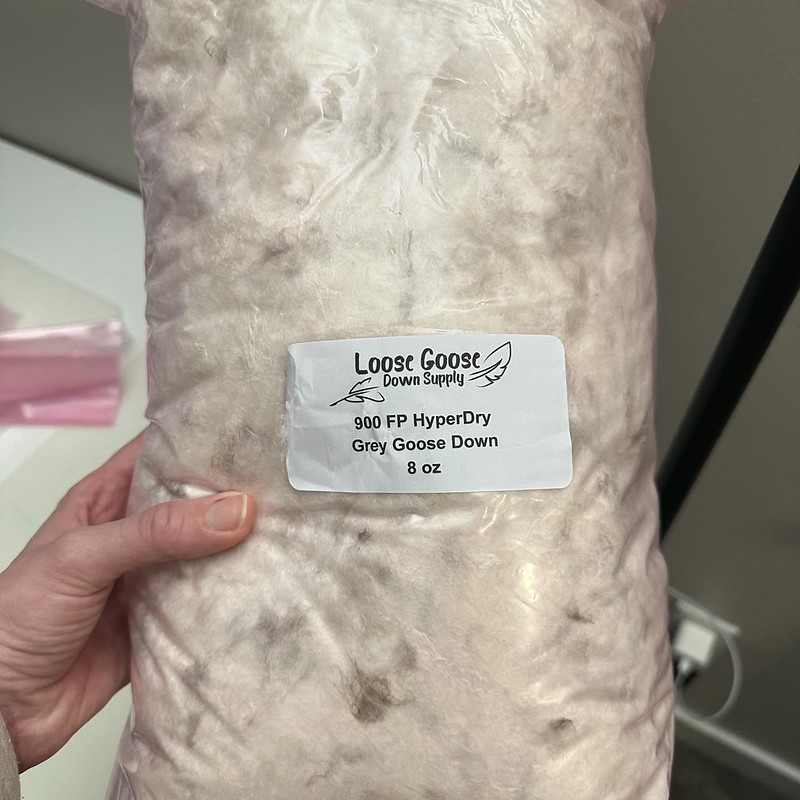
After researching the internet, the company that consistently gets high reviews is Loose Goose Down Supply. And for good reason! After working with the down, it was well-cleaned and packed, not clumpy, reasonably sorted, and I encountered less than a dozen feathers. I had a heck of a time deciding what type of down to use and how much I needed, so let’s talk about the features of down.
Fill power (FP) is the cubic inches of an ounce of down. That means 1 ounce of 850 fill power will take up 850 in3 (14.72 quarts, 13.93 liters). Meanwhile, 1 ounce of 1000 fill power will take up 1000 in3 (17.32 quarts, 16.39 liters). Fill power is a way to describe how high quality the down is. The poofier the down, the better. Note that the fill power doesn’t tell you how warm the jacket will be, just how much down you’ll need to fill a volume. You will need more down if using 750 FP and less if using 1000 FP to achieve the same volume. Consequently, the higher the fill power, the lighter the final jacket since less is needed for the same volume.
Fill weight is just the amount of down in a jacket. In other words, how heavy is the down, usually given in ounces (oz) or grams (g). Easier if it is in ounces.
Fill volume is calculated by multiplying fill power (in3/oz) and fill weight (oz). The ounces cancel out, and you get the overall volume in cubic inches. Fill volume will tell you more about how warm the jacket is, but you still need to consider its overall size and design to estimate potential volume. For example, size XS will need less fill volume than size 5X. Fill volume will differ between jackets with and without a hood. Ready-to-wear companies tweak the fill power and fill weight of their jackets to optimize cost and performance.
As I mentioned in the intro, I’m replacing a 10-year-old Arc’teryx Thorium AR jacket. My old jacket is a size L, and it needs to be at least an XL now. I also wanted to add a hood to my jacket and lengthen the hem to cover my rear end fully. After some sleuthing, I found how much down is used in the Thorium AR jacket. For a women’s size medium with a hood, the jacket is filled with 3.7 oz of 750 FP for a total of 45.52 L of down.
| Jacket | Fill Power (in3/oz) | Fill Weight (oz) | Fill Volume (L) |
|---|---|---|---|
| Thorium AR* | 750 | 3.7 | 45.52 |
I knew I needed more fill volume because I wanted my jacket bigger and slightly longer. I debated between the 900 and 1000 FP from Loose Goose supply. Ultimately, I went with 900 FP because it was still far nicer than my old jacket and wasn’t nearly as expensive as the 1000 FP. I rounded up to 50 L (pure guess) and calculated how much of the 900 FP down I would need at a minimum:
50 L = 3051.19 in3
3051.19 in3 ÷ 900 in3/oz = 3.39 oz
Loose Goose sells in quantities of 4 oz, 8 oz, and 1 lb. I was too close to 4 oz and wanted to ensure I had enough down, so I bought 8 oz. I can always make myself down pants later. Even though this was a ballpark estimate, it was helpful to know that if I filled my jacket with 3.5 to 4 oz of down, I should achieve the same amount of warmth as my old jacket.
To read more about insulation, check out this helpful blog post.
Notions
I buy all of my zippers from Zipperstop now since I’m able to get the whole variety of YKK zippers. I purchased a 36-inch long #5 Vislon molded separating zipper. I wanted to go with a #3 zipper, but it didn’t come in the color I needed, so I had to go larger. The #5 zipper works and isn’t too bulky.
I shortened my zipper according to the pattern instructions and used #5 top stops from Wawak.
Miscellaneous
The thread and needles are also from Wawak. I used Gutermann Mara 100 poly-wrapped poly core thread (Tex 30) and Organ Microtex needle size 70/10.
My sewing machine came with a walking presser foot. I would suggest using a walking presser foot to help feed the fabric evenly through your machine, especially since you will need to quilt the pieces together before filling the chambers with down. A walking presser foot is an essential tool for quilting.
Other supplies included a sturdy box, binder clips, heavy paper, tape, and chopsticks. I followed the method used by the Functional Clothing Lab for stuffing the chambers.

Subscribe to continue reading
Become a paid subscriber to get access to the rest of this post and other exclusive content.
