In this post, I will discuss a second way to measure your body for pants. The previous method had some validity concerns as it only considered the widest part of your torso, which doesn’t provide information about the relationship between your waist, hips, and upper legs. Relying solely on your widest circumference to determine your pant size can lead to inaccurate sizing. Based on the objectives outlined in the first part of this series, I will review the strengths and weaknesses of using a yardstick to improve upon the traditional hip measurement approach.
Objectives
Briefly, the four objectives are to use descriptive language when explaining the method, use quantitative measurements whenever possible, be reliable across users, and take a holistic approach incorporating the entire body rather than individual parts for validity.

Based on the report card, the yardstick method has several weaknesses. Specifically, the technique would greatly benefit from more detailed instructions. Given the lack of instructions, I do not know with certainty that this method solely relies on quantitative measurements. Regardless, multiple factors contribute to the unreliability of this method. In addition to these weaknesses, this method still may not yield the most accurate size selection. This is due to the method’s failure to account for factors such as thigh and butt shape and posture, all of which are vital in determining the appropriate size.
Descriptive
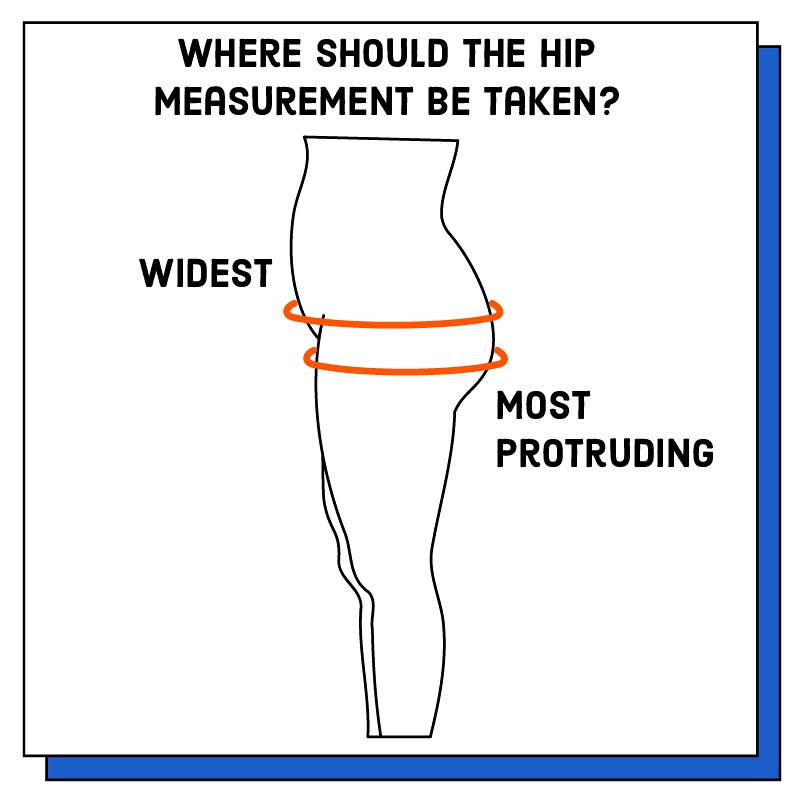
As mentioned in my previous post, the majority of pattern companies recommend utilizing the widest section of your torso for the “hip measurement” and determining the appropriate size based on this measurement. However, I found only a few pattern companies that propose a different measuring approach. Unfortunately, neither method clarifies where the initial hip measurement should be taken, the widest part or the most protruding part in the back?
The first mention is from Lekala Sewing Patterns, “Hip measurement is taken around hips and the measurement tape is put to your skin. This is the actual hips circumference. Full hip measurement is measured taking into account belly protuberance and is always more than hip measurement. You can take the full hip measurement while holding something vertically next to your tummy (e.g. a ruler) and measuring at the same level as you would when measuring hips, around the buttocks and hips and than to the ruler, which means you take the measurement tape off your skin and it passes around the ruler in the air.”
The second mention is from Itch to Stitch. Unfortunately, they admit that the traditional method is what is included in their pattern instructions, “Most of the pattern instructions I’ve seen, including American sewing patterns such as the ‘Big 4’ and European sewing patterns such as Burda and Patrones, tell you to simply measure the widest part of your hips. In fact, I have similar instructions in my own Itch to Stitch patterns for simplicity’s sake.”
Quantitative Measurement

The lack of guidance on where to place the tape measure at the beginning of the process makes it unclear if this method only relies on quantitative measurements. I’m only assuming, but I believe the hip measurement should be taken where the rear end protrudes the most. However, it is essential to note that instructions that require estimating the most protruding part are based on personal perceptions rather than precise measurements. These steps require standing in front of a mirror and judging one’s body.
Why is it so important to avoid making size and shape judgments about our bodies? First, these observations about our body, shape, and proportions can vary depending on personal perceptions and biases, leading to inaccurate measurements and invalid results. Moreover, making qualitative judgments regarding our appearance can significantly impact our body image and overall well-being. Methods heavily relying on subjective judgments cannot truly be considered “body-neutral” since personal biases can influence these judgments. Even seemingly objective assessments, like anterior or posterior pelvic tilt, can unintentionally perpetuate harmful stereotypes and reinforce the notion that certain body types are more desirable or acceptable than others. It’s frustrating to see when you Google search “pelvic tilt,” you only get websites interested in “fixing” those issues.
Reliability
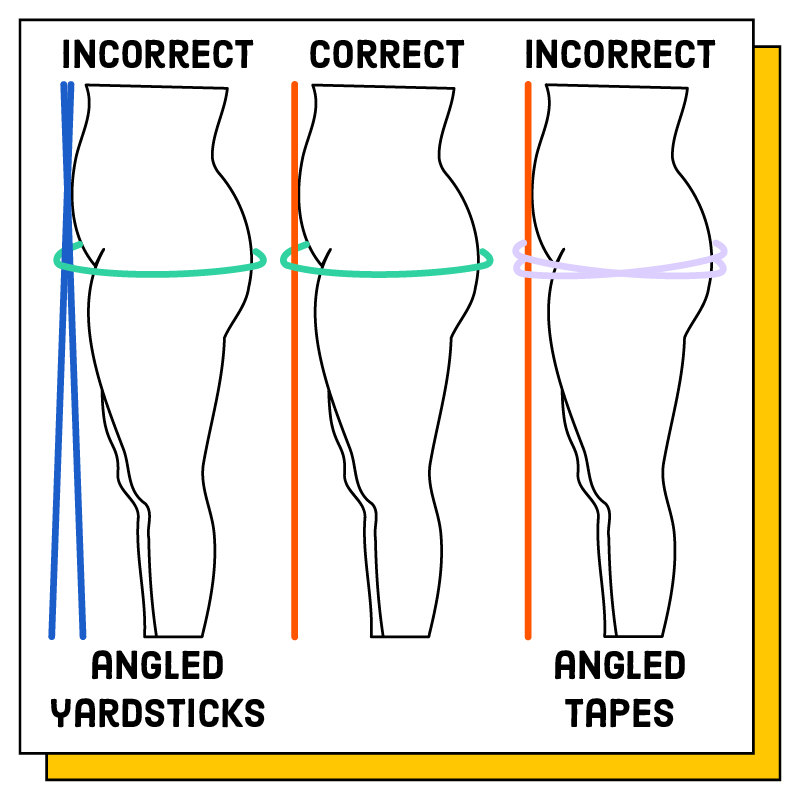
Various factors can affect the accuracy of measurements, and this particular method has some unique challenges that can significantly impact the results. Firstly, it is crucial to take the measurements at the same level every time and ensure that the tape measure is held horizontally, whether that measurement is at the widest part or at the level where the butt protrudes the most. Secondly, the yardstick placed against the belly must be perfectly vertical and not tilted. Measuring your body the same way with all the multitasking required will lead to variable results. Overall, I believe this method is unreliable.
Validity
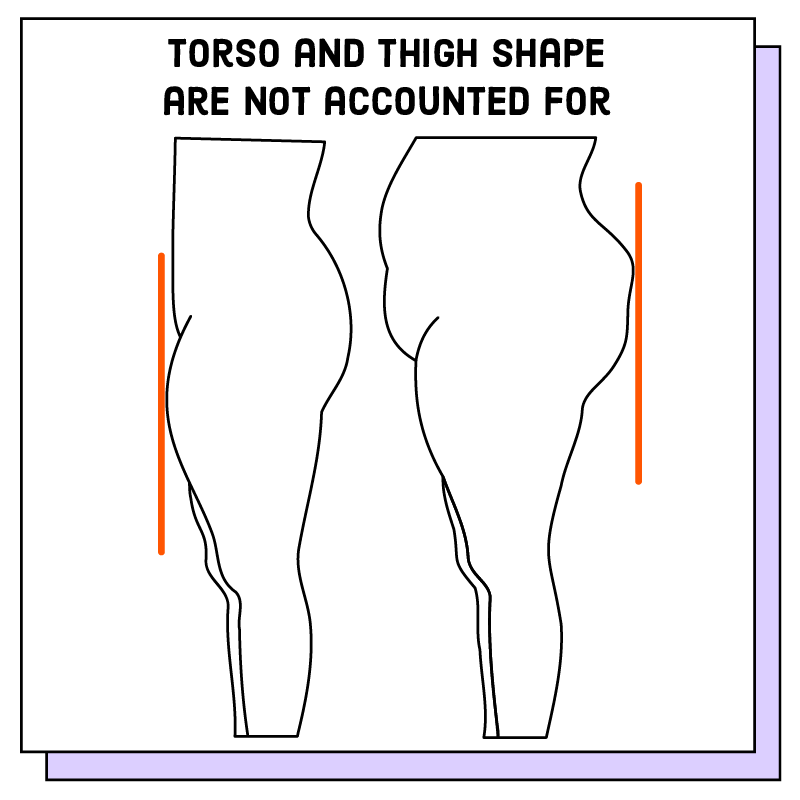
When determining pant size, considering stomach projection is a more accurate approach than solely relying on the hip circumference. However, the method fails to consider thigh and butt shape and posture, which are crucial factors in selecting the appropriate size. Moreover, due to its lack of detailed instructions, issues with obtaining just quantitative measurements, and serious reliability concerns, the validity of this method remains uncertain.
Solutions
The solutions are very similar to the solutions outlined for the first method. I would like to reiterate that it is important for everyone to advocate that pattern instructions include detailed guidance for every step. It is disheartening that Itch to Stitch still publishes the outdated technique in their instructions, even though they know it will result in inaccurate sizing.
In general, this method would be greatly improved if it was written as step-by-step instructions. The instructions should provide clear guidance on where to place the tape measure and how to hold the yardstick against the front body. Visual aids should encompass a wide range of body shapes.
Second, any step (i.e., estimate back body protrusion) that requires the use of qualitative judgments or estimates should be removed and replaced with ways to quantitatively measure the body. This would improve the accuracy and reliability of the results.
Finally, a more effective measuring approach should still be considered. This new approach should focus on quantifiable data. The approach should aim to measure the widest overall circumference of the whole torso, taking into account posture, hip width, and protrusion of the stomach, butt, and upper thigh. It’s crucial that this method should be agnostic to the location of any body part or the degree of protrusion.
I’m genuinely looking forward to discussing the last method! Instead of using a tape measure with additional tools, the last method uses poster board to acquire the overall circumference of the torso. I believe this approach shows great potential and effectively meets the goals of being reliable, valid, and qualitative.

IF YOU FOUND THIS POST HELPFUL, CONSIDER SUPPORTING MY WORK BY SIGNING UP FOR A PAID SUBSCRIPTION.
POSTS OLDER THAN 3 MONTHS ARE NOW FOR SUBSCRIBERS ONLY — YOUR SUPPORT KEEPS THIS SPACE GOING.
INTERESTED IN SUBSCRIBING TO RECEIVE NEW POSTS IN YOUR INBOX?