Hello again. This is the second part of a two-part series. In the first part, I outlined some important objectives I believe any process should prioritize, especially when measuring, sizing, and fitting pants because these fundamental goals help improve accessibility and inclusivity. In this post, I will use these objectives to evaluate the first of four methods for measuring your body and determining a suitable pant size. I understand that discussing all four methods in one post would be cumbersome, so I decided to focus on one at a time. My two-part series just turned into five separate blog posts! “NOBODY expects the Spanish Inquisition!”
Objectives
Here are the objectives from part one:
- Descriptive: Methods and techniques should avoid jargon and buzzwords and instead use neutral, descriptive language.
- Quantitative: Methods and techniques should use quantitative measurements whenever possible and minimize the need for descriptive or subjective evaluations.
- Reliable: Methods and techniques should produce consistent results across different users (external reliability), and individuals should be able to replicate the same results each time (internal reliability).
- Valid: Methods and techniques should take a holistic approach incorporating the entire body rather than individual parts to maximize validity.
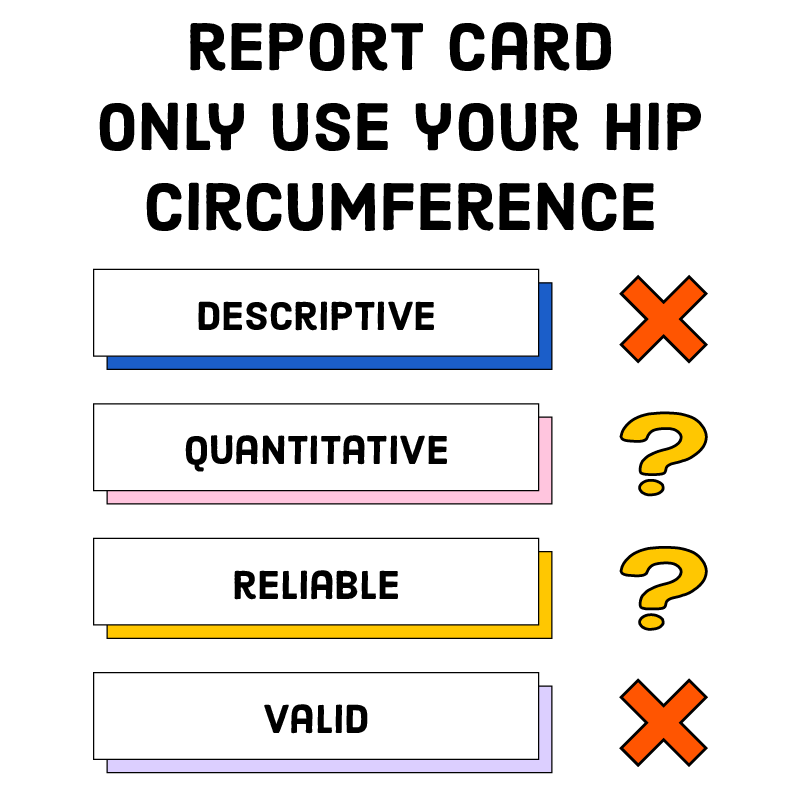
Based on the report card, this method has several weaknesses. Specifically, the method could benefit from more detailed descriptions. Caution should be taken to ensure the quantitative measurement is taken accurately and reliably. However, your measurements will likely not result in selecting the correct size regardless, making this approach not valid.
Descriptive Language
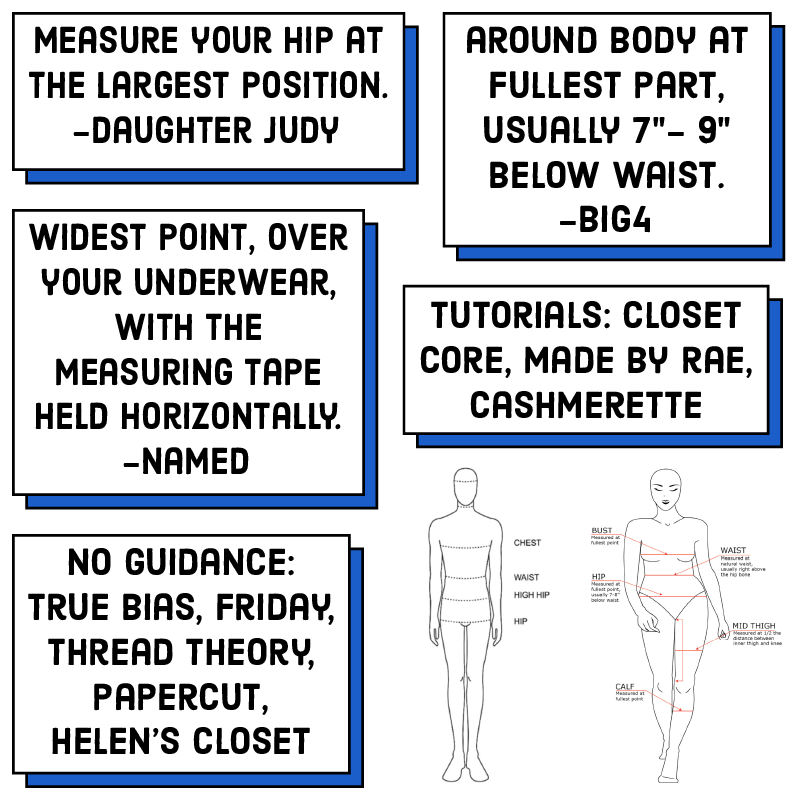
What is your hip measurement? While hip measurement may be considered a commonly used term within the sewing industry, everyone may not understand it universally. Pattern companies are inconsistent with their guidance and instruction on obtaining a hip measurement. Several pattern companies have provided written / photo details: Closet Core Patterns, Made by Rae, Cashmerette, and Muna and Broad. However, many companies seem to opt for a brief and vague explanation, a generic image, or worse, no information.
Word usage and meaning can become confusing in situations without clear agreement within a community. For example, Closet Core uses “hip” and “full-hip” interchangeably, “We recommend *the hip measurement* to be measured around your body at your widest hip. Using the mirror, try to ensure the tape is level front to back. You can slide the tape up and down till you find where you are widest. *This is what we call full hip* and is one of the main measurements that we use to find pants sizes or general sizes for a dress/jumpsuit etc.”
On the other hand, many in the community define “hip” and “full-hip” as two different terms and, for many bodies, will be different values. Full-hip is the widest part of your hips PLUS any extra room needed to accommodate your shape. Whereas hip measurement just means the widest part of your body and does not account for your shape or posture.
Quantitative Measurement
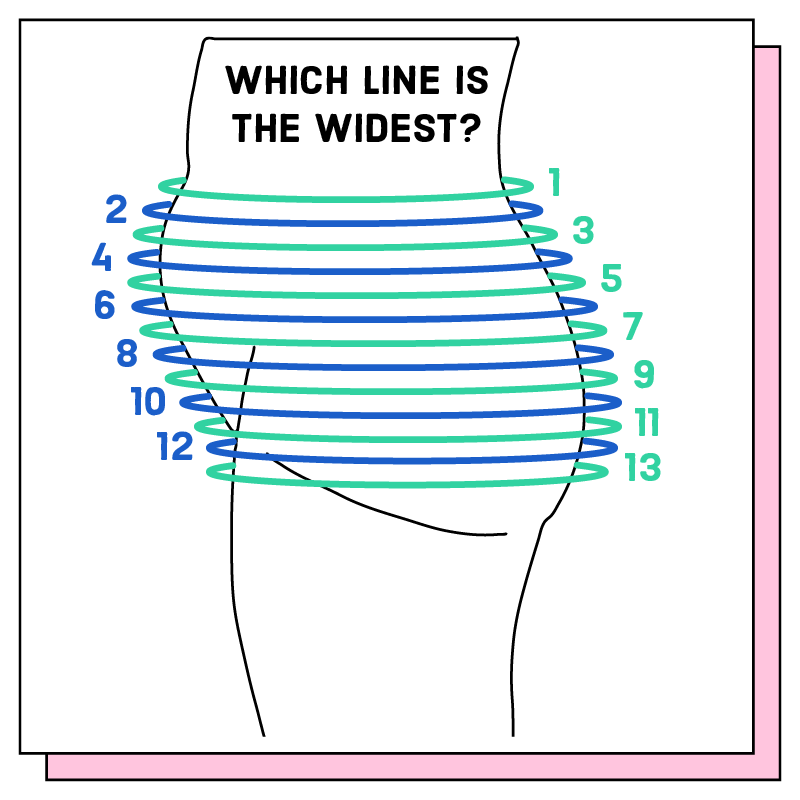
Fortunately, this approach solely relies on quantitative measurements. However, a method that requires tedious and systematic measurements may be overlooked in favor of a quicker and more straightforward approach. The most accurate way to determine the widest part is by sliding the tape measure up and down, but this is time-consuming. Many people will rely on guesswork, leading to bias and decreased accuracy. In the diagram above, which line would you guess is my widest circumference?
Reliability
Consistent measurements are essential for achieving good reliability, which means that the same results should be obtained every time (internal reliability), regardless of who takes the measurement (external reliability). If you always slide the tape measure up and down to find your widest part, you’ll have better reliability, but if you are guessing where your widest part is located, you will have lower reliability. With enough experience, you might be able to measure yourself in the exact location repeatedly to get the same measurement. However, if you asked 100 strangers to guess your widest part and measure your hip circumference, you’d get varying results. If you guessed line 7 above, you are correct. I didn’t guess correctly; likely, many of you didn’t either.
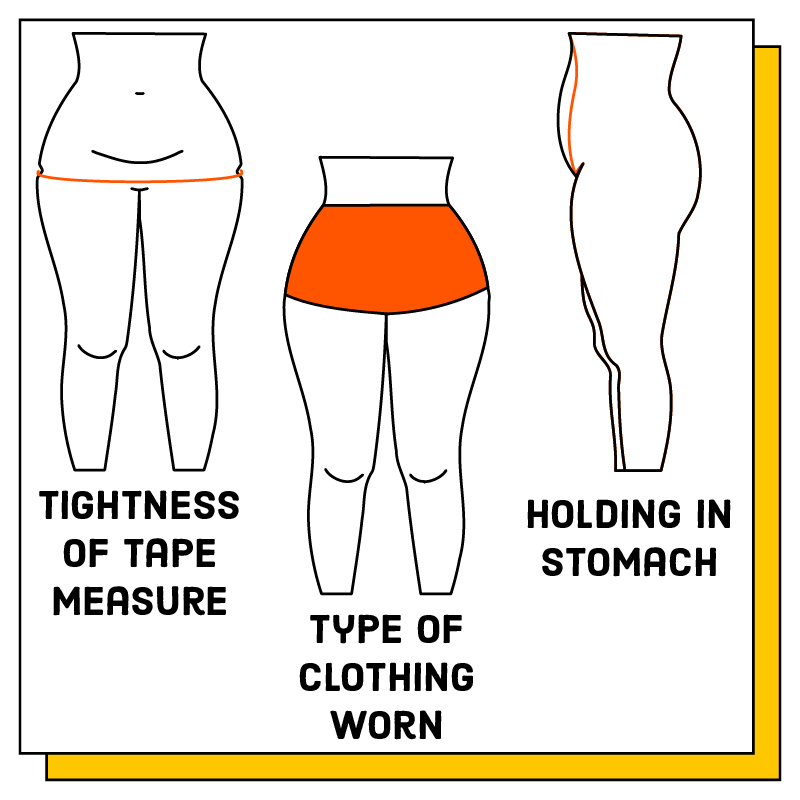
Here are some other factors that impact reliability. These factors aren’t exclusive to this method but must be included in a comprehensive description of how to measure your body. If the tape measure is too tight or loose, it can alter the result. Additionally, the type of clothing worn during the measurement will also have an impact. It’s important to consider whether to measure over clothes or only in underwear. Any attempt to manipulate body posture, such as sucking in or puffing up the body, can also affect the accuracy of the measurement.
Validity
Even after all of that, relying solely on your hip measurement to decide on your pant size likely will result in inaccurate sizing (low validity). Your posture, body shape, and the intricate interplay between your waist, hips, and upper legs all have a role in determining your overall size. It’s crucial to consider all these factors when selecting your size. For instance, if 100 people have a 42-inch hip circumference, they will not all fit in the same pant size. Guarantee!
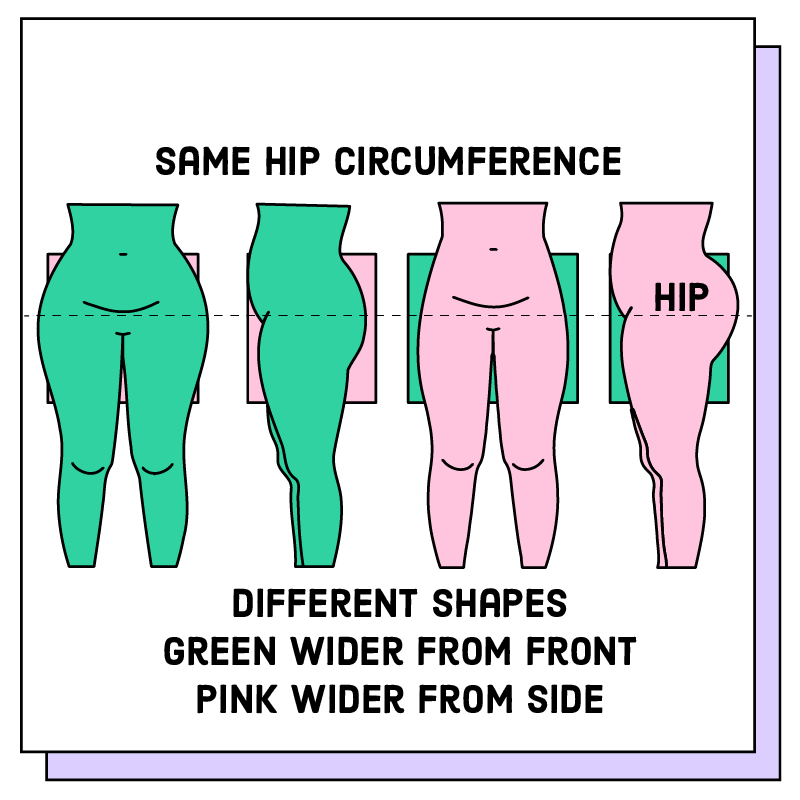
In the following figure, you can see how shape can impact the fit of pants. The two individuals, one in green and one in pink have different widths across their front body and side view at the hip level. Although the green person appears wider from the front, the pink person has a more prominent butt when viewed from the side. Simply relying on hip measurements to choose a size won’t be enough unless you have the same exact body shape as the dress form or person used to create the pattern.
Conclusion
Each year, I am required to complete a refresher course on good lab practices. A crucial takeaway from this course is the importance of having a Standard Operating Procedure (SOP) for accurate and trustworthy data collection. The SOP offers a detailed guide for all relevant study activities and helps establish consistent guidelines. Similarly, pattern companies provide an instruction booklet with each pattern, which serves as an SOP. We should advocate for more accurate and comprehensive information to ensure that the instruction booklets offer detailed guidance for every step. Don’t hesitate to contact the pattern designer with your questions and concerns. This will indicate to the company that they need to include further instructions.
To enhance accessibility, companies should prioritize providing clear instructions about measuring that are easy to comprehend. Visual aids or diagrams can be added to assist those who may have difficulty reading or understanding text-based instructions, like individuals whose native language is not English.
Additionally, offering guidance on how to take measurements across different body shapes can promote inclusivity and representation for everyone. Although it’s excellent that Make by TFS shares the model’s measurements and corresponding size, it would be even better if they demonstrated the measuring process on each model too.
Finally, even these steps may be insufficient since it is difficult to truly represent all body shapes. A better measuring approach should be considered. The next three posts will cover methods that try and improve the validity of picking the correct size.

IF YOU FOUND THIS POST HELPFUL, CONSIDER SUPPORTING MY WORK BY SIGNING UP FOR A PAID SUBSCRIPTION.
POSTS OLDER THAN 3 MONTHS ARE NOW FOR SUBSCRIBERS ONLY — YOUR SUPPORT KEEPS THIS SPACE GOING.
INTERESTED IN SUBSCRIBING TO RECEIVE NEW POSTS IN YOUR INBOX?