
Welcome to a two-part series that aims to teach everyone a simple technique for measuring and determining your pant size. Finding a new-to-me method got me thinking about how I evaluate techniques and what makes a technique “good.” In part one, I’ll introduce key objectives that any method or technique should strive to achieve to maximize accessibility and inclusivity. This discussion builds upon my Instagram post about how Stories are, by nature, discriminatory. In part two, I’ll evaluate several techniques for measuring your hips, including a new-to-me method, and use the objectives established in part one.
Words Have Meaning
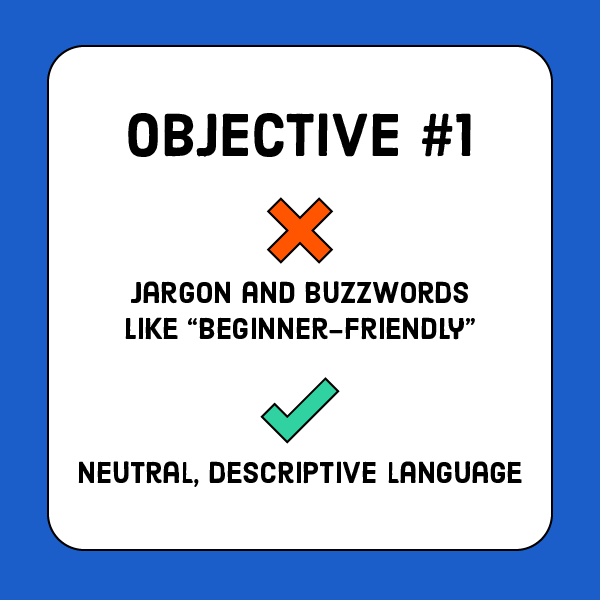
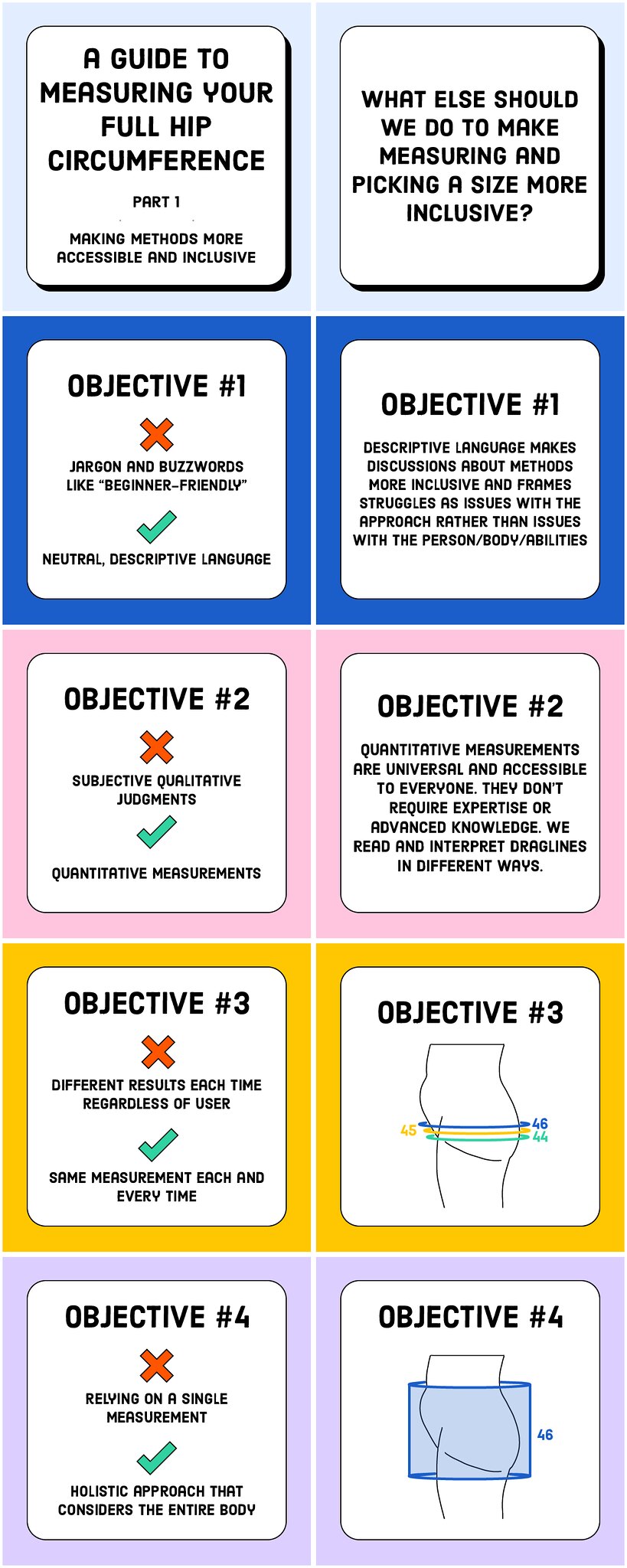
Unfortunately, the sewing community sometimes uses buzzwords and jargon to make pant fitting seem easier than it is. Describing a tricky process like pant fitting as “beginner-friendly” belittles the experiences of those who find it genuinely challenging. This reinforces the notion that pant fitting should be effortlessly achievable for everyone. It also fosters an atmosphere that discourages learning from failure and mistakes. Sewers are more likely to blame themselves and their perceived inadequacies when faced with challenges. A lesson I learned from my undergraduate research mentor, I believe everyone can be successful fitting pants with enough support, knowledge, experience, and patience. Descriptive language makes discussions about methods more inclusive and frames struggles as issues with the approach rather than issues with the person/body/abilities. We should all do what we can to foster a community that celebrates both successes and failures!
Data-Driven Decision Process
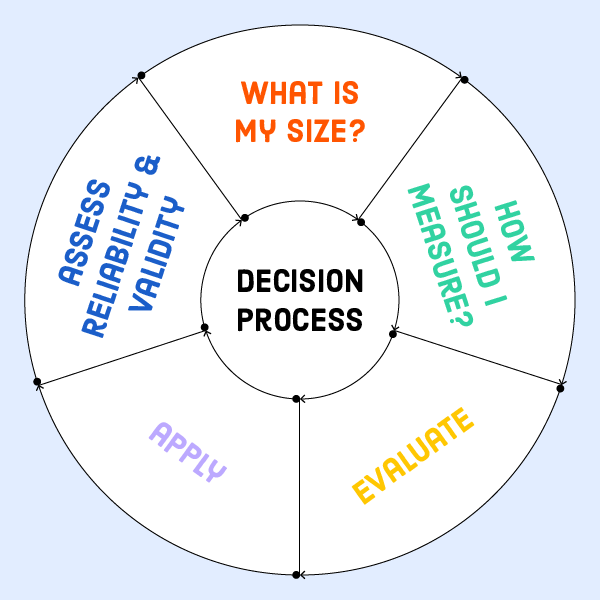
When it comes to making data-driven decisions, we all generally follow the following process. First, ask a question. Next, gather relevant information and data. Then, evaluate the results and apply them to the decision. Finally, reassess the question if necessary.
Ask Question
| Size | 00 | 0 | 2 | 4 | 6 | 8 | 10 | 12 | 14 | 16 | 18 | 20 |
|---|---|---|---|---|---|---|---|---|---|---|---|---|
| Waist | 23.5 | 24.5 | 25.5 | 26.5 | 27.5 | 28.5 | 30 | 31.5 | 33.5 | 35.5 | 37.5 | 39.5 |
| Hip | 34 | 35 | 36 | 37 | 38 | 39 | 40.5 | 42 | 44 | 46 | 48 | 50 |
For this blog post, my question is, “What pant size should I pick?”. I will use the body measurement chart from Sew House 7 as my example. There are 12 sizes, and how do we know which size is the best option? The best way to answer this question is to acquire data.
Acquire Data
When it comes to making a decision, the second step involves gathering data. However, a major challenge arises as to what data should be acquired. Should we focus on waist circumference, hip circumference, or hip circumference adjusted according to our posture and perceived shape? Some experts suggest gathering an even more extensive list of measurements, including high hip circumference, inseam length, outseam length, pant rise, and crotch depth. This is a great chance to explore the different types of data that can be gathered in general and weigh the advantages and disadvantages of each.

Qualitative Data Requires You to Judge Your Body
Qualitative data pertains to non-numerical and descriptive information usually gathered through observations. For instance, describing and interpreting draglines on a garment. As I’m sure most of you know, I strongly object to reading draglines. Qualitative data have its limitations as being subjective. People tend to interpret observations differently based on their experiences, perspectives, and backgrounds. We do not all read and interpret draglines in the same way.
Additionally, in the context of pant fitting, qualitative data cannot be impartial to one’s body shape and size. It has felt a bit misleading to describe my current method of picking a pant size as impartial because part of the decision process involves judging my own body. I have to consider factors such as whether I have a forward-tilting pelvis, a prominent belly, or protruding buttocks. First, using descriptive methods to adjust sizing might accidentally leave someone out. What if the size adjustment decision-tree doesn’t account for all body types? Second, these qualitative judgments can be harmful to one’s body image. Any method that relies on qualitative data isn’t body-neutral. A body-neutral measuring technique should be usable and accessible by everyone and should include all body shapes and sizes.
Quantitative Data are Body-Neutral
Numerical measurements form the basis of quantitative data. An example would be comparing the center grainline of your body, as represented by a laser level, to that of the pant’s center grainline. Quantitative data is objective and crucial for making data-driven decisions, such as selecting the appropriate pattern size.

I am ignoring methods at the moment. That’s part 2 of this series. Let’s say I was able to measure my waist, hip, and full-hip, which includes shape and posture with the hip circumference. My waist is 36 inches, hip is 44.5 inches, and full-hip is 46 inches. I’ve acquired data and can now determine what size to use.
Evaluate
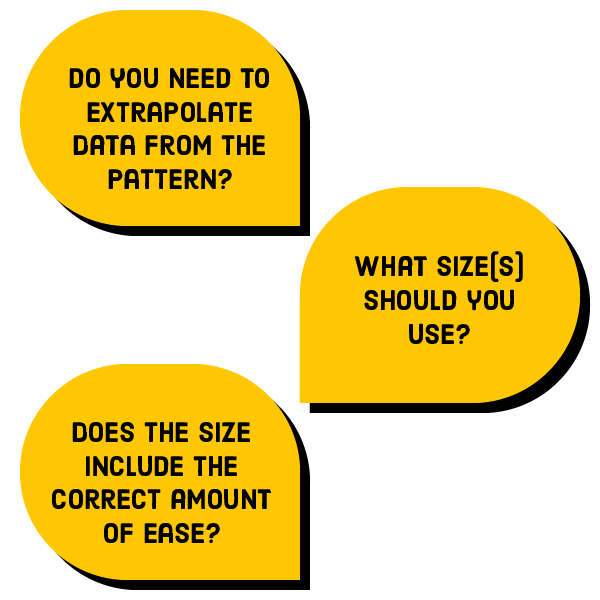
Once you’ve acquired all your data, you need to evaluate it as it pertains to your question. Remember, you might sometimes need to extrapolate information from the pattern pieces. For example, the pattern may only include full-bust measurements on a pattern drafted for a B-cup. If you want high-bust information, you’ll have to calculate that yourself. Sometimes you may have to straight-up measure the pattern pieces to obtain information like chest width across the front and back. The instructions and tables included with patterns don’t always come with everything a sewer needs to make correct size decisions.
| My Measurements | Size | |
|---|---|---|
| Waist | 36 | 16-18 |
| Hip | 44.5 | 14-16 |
| Full-Hip | 46 | 16 |
Based on all your measurements (high bust, bust, waist, full hip, upper thigh, etc.) and any extrapolated data, you can associate each measurement with a size from the size chart. You will likely have multiple sizes. Pick the largest size as your starting point. I would probably choose size 16 in this example.
| 14 | 16 | 18 | |
|---|---|---|---|
| Waist without elastic | 45 | 47 | 49 |
| Hip | 47 | 49 | 51 |
I encourage everyone to use the final garment measurement table whenever possible, particularly for pants. The full-hip measurement technique I describe in part two gives you a number to compare against the final hip circumference of a garment.
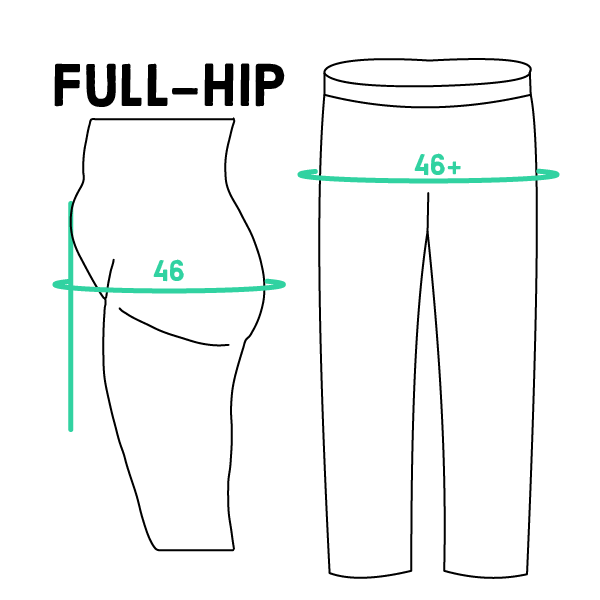
In the case of woven pants with no stretch, if your full-hip measures 46 inches, the final hip circumference of the garment should be 46 inches or larger. This is what I mean when I ask, does the size include the correct amount of ease? In the example above, I need to double-check that size 16 has a final hip measurement of at least 46 inches, and it does. The final hip measurement of size 16 is 49 inches.

As a side tip, for pants with an elastic waistband, make sure the waist without elastic will fit over just your hips. In my example, the waist without elastic needs to be 44.5 inches or bigger and it does. Size 16 has a waist without elastic measurement of 47 inches.
| 14 | 16 | |
|---|---|---|
| waist without elastic | 45 – 44.5 = +0.5 | 47 – 44.5 = +2.5 |
| hip | 47 – 46 = +1.0 | 49 – 46 = +3.0 |
Given all the criteria, I could try either size 14 or 16. How to choose? Size 14 would only give me 1 inch of positive ease at the hip for sitting and moving and barely enough room to fit the waistband over the widest cross-section of my hips. One inch of ease is not very much across 8 seams. On the other hand, Size 16 would give me 3 inches of positive ease at the hip and 2.5 inches of room when I try and fit the waistband over my hips. Three inches of positive ease is significantly more across 8 seams. Trying to fit pants that are too small is a waste of time. I will always default to the larger size because it is easier to take in seams than try to add after the fact.
Apply
Once you’ve picked your size, you can create your test garment. I prefer to start with a single-leg mock-up and a detached waistband for pants. I always make multiple muslins, so once I’m happy with the crotch length, I move on to assessing the center grainline placement at the knee and hip. I like to use a full mock-up with both legs for the center grainline stuff. But this post isn’t about fit methods because that’s another question and a new decision process.
Assess Reliability and Validity

Consistent measurements are essential for achieving good reliability, which means that the same results should be obtained every time (internal reliability), regardless of who takes the measurement (external reliability). However, maintaining consistency when using a tape measure can be difficult, as it can be challenging to position it accurately, leading to some degree of variability in the final measurements. This can negatively impact reliability, which is especially crucial when measuring the full-hip region. Even a slight variation of 1/2 inch can significantly alter the final result.
When choosing the right pant size, it’s important to consider how the data was collected. Achieving high validity requires acknowledging that multiple factors contribute to the overall fit. Relying on a single measurement won’t suffice. Instead, we need to assess your entire torso as a unified system, from waist to hips, to make more informed decisions. The method lacks validity if a measurement results in an incorrect pant size.

Summary
These are the four key objectives that any method or technique should strive to achieve.
- Methods and techniques should avoid jargon and buzzwords and instead use neutral, descriptive language.
- Methods and techniques should use quantitative measurements whenever possible and minimize the need for descriptive or subjective evaluations.
- Methods and techniques should produce consistent results across different users (external reliability), and individuals should be able to replicate the same results each time (internal reliability).
- Methods and techniques should take a holistic approach incorporating the entire body rather than individual parts to maximize validity.
I hope this post inspires everyone to consider ways to promote inclusivity and accessibility in conversations about measuring and size selection methods. Feel free to share your comments or thoughts below. What other steps can we take to ensure that measuring and selecting a size is inclusive for everyone?

IF YOU FOUND THIS POST HELPFUL, CONSIDER SUPPORTING MY WORK BY SIGNING UP FOR A PAID SUBSCRIPTION.
POSTS OLDER THAN 3 MONTHS ARE NOW FOR SUBSCRIBERS ONLY — YOUR SUPPORT KEEPS THIS SPACE GOING.
INTERESTED IN SUBSCRIBING TO RECEIVE NEW POSTS IN YOUR INBOX?

Thank you for this. It’s very interesting to break down the steps that many of us go through subconsciously. Especially, since we may be missing an important step or consideration.
I’m just confused why you mention that the Waist without elastic measurement of 45″ is enough to go over a 46″ full-hip. Is there bound to be some stretch in the fabric?
I’m enjoying your blog and appreciate your scientific approach. Looking forward to your next post.
Chris
Excellent question. I’ve updated the post and added more figures that hopefully clarify everything. Hip and full-hip are two different terms and, for many bodies, will be different values. Full-hip is used to select a size, and hip can be used in circumscribed situations like this to double-check that the final waistband will fit over the body. The full-hip measurement incorporates your shape and posture. It measures the widest part of your hips PLUS any extra room needed to accommodate your shape. When you use this measurement to pick your size, you are choosing a size that fits your hips and is drafted to fit your crotch curve as well. On the other hand, a hip measurement is just the circumference at your widest section and does not include anything about shape or posture. This measurement is only helpful when making elastic waistband pants since you can use this measurement to make sure the waistband without elastic can fit over your widest part. If you have a pattern with a zipper or some other opening/closure, then this doesn’t apply. Hope this makes more sense, and feel free to ask additional questions for further clarification.